Featured Creative: David Faltrego – Surreal Artist

Editorials

les citroen

I love surreal art, Dali is one of my favourite artists in fact. So when I discovered David Faltrego’s work at Medway Open Studios last year I was excited to find a local artist creating surreal artwork. I thought everyone would be interested to find out more about David, who lives in Medway,  so here is a little interview with him…

So David, tell us more about your background and how you ended up creating surreal artwork?

Just prior to leaving school I was briefly interviewed by a recruitment representative from Maidstone Art College who wasn’t impressed. I had insufficient supporting grades, my portfolio was apparently of an unexceptional calibre and my “bolshie” attitude probably sealed my fate! I seriously doubt I would have lasted the course anyway as I don’t listen or rather I take on board only what interests me.

Today I paint whatever I please, as and when I please…

Other than an “A” Grade O Level, I’ve no further art qualifications. I have no awards and since I never submit to competitions I never will. Paradoxically my greatest delight in winning any award would be in politely declining it!

As a surrealist it can be a struggle both selling work and gaining acceptance into a gallery, since this particular genre is generally frowned upon and receives little credibility within the art world, particularly in the UK. Never the less I continue to plough a lone furrow quite simply because this is what I enjoy.

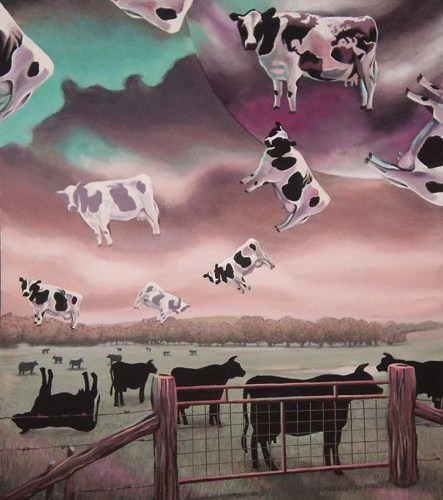
cattle of an udderworld

I began painting as a hobby, doing quite a lot of commission work throughout the 1980’s. However, by the end of the decade I’d become thoroughly bored with it all, I never really enjoyed commissions – but it funded some travelling at the time. This coincided with several galleries declining to show my work, leaving me totally disillusioned with the Art world. It was a further 12 YEARS before I picked up a brush, following persistent badgering from an ex work colleague who was into the “arts”. This time I was determined to do it differently – No more commission work and no appeasing others tastes. Self-indulgent? Absolutely!

I gradually amassed a small body of work to compliment my older material. By chance in passing, I stumbled upon the Nucleus Gallery in Chatham and I asked if I may hire their gallery for an exhibition. For the very first time I received a positive response without the stuffy, elitist attitude.

I had my first solo exhibition in May 2010, followed by two more in 2011 and 2012 and the feedback has generally been very good. Of course I cannot hope to please everybody, after all art is essentially subjective. You wouldn’t expect an opera lover to attend a punk rock concert but it’s still all music of sorts.

magic roundabout

Is your art your main income?

I know I’ll never make a living from painting, therefore it has always remained something I do in my spare time because I enjoy it. To pay the bills I have always worked in the printing industry as a Finisher, for a number of different companies in Kent.

Who inspires you both locally and universally?

Locally I would have to say several people connected with Nucleus Arts who have offered me encouragement particularly at the shops in Rochester and Maidstone.

On a much wider scale – since much of my work makes references to my childhood growing up in the 60s-70’s then my parents must take some credit. We certainly never had the material things but we did have everything that really matters, resulting in some of the best times that live on in my memories and sometimes resurface in my works.

Anything that messes with the logical way of thinking, the absurd, random thought process, etc – that’s what fascinates me!

Inspiration maybe stretching it but my art tutor at school could take some credit for allowing me virtual carte blanche to express myself rather than push me into the “traditional” route as he did with most others – although I’d have probably done as I please regardless! Universally, Artists I admire – Dali and Magritte (obviously), also Brueghel, Bosch and Vermeer who weren’t surrealists.

The music of the Beatles (post 1967) and Pink Floyd has influenced my thinking certainly. I’ve long since found inspiration from the surreal humour of Python and more latterly Eddie Izzard as well as the dark tales of the Brothers Grimm. Anything that messes with the logical way of thinking, the absurd, random thought process, etc – that’s what fascinates me!

serving the master

What are your plans for the future?

The future?, who knows. Currently I’m nearing completion of a whole new set of work due for exhibiting in August 2013 at Nucleus Chatham. Ideally I would like my work to be acknowledged with more credibility but I won’t hold my breath. A wider audience would be nice – that’s all.

Are there any other skills you would like to learn?

Other skills – not really. I’ve already discovered what I enjoy most and indeed what I do best. I simply wish to continue improving on what I’m already doing. As long as I have the ideas and desire to paint I will do so, but if or whenever I feel my standards are falling or I become disillusioned again, I will stop.

Are there any website you enjoy looking at?

I view Deviant Art, Red Bubble and Saatchi Gallery from time to time.

Thank you so much David for talking to us, we are really looking forward to seeing more of your work at the exhibition in August!

toys in the attic

Area:   UK   Britain   East of England   East Midlands   London  North East   North West    Yorkshire    Scotland    South East South West    Wales   West Midlands

Gig Review – Post War Years – Cargo – 25th February 2013

Editorials

PWY Cargo

The joy with future music, is that we can only guess what it will be, and it doesn’t yet have a genre. Having just read a review of Post War Years new album, Galapagos, my thoughts are only confirmed. The review said “It’s tough to discern the group’s creative direction”. How can a new sound have a direction? It should stand on it’s own feet and become its very own genre of music. And that is how I feel about the music performed by Post War Years.

Having heard “All Eyes” on the first episode of the new Top Gear series, I instantly fell in love with their sound, and knew I had to see them live. The next nearest gig also turned out to be their album launch, so that obviously made me even happier!

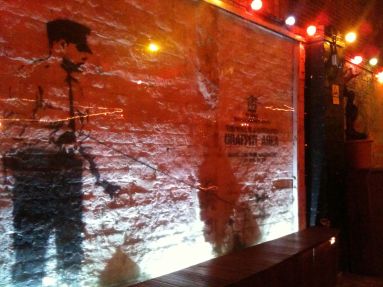
Cargo is a fab venue, with Banksy graffiti  in the garden and situated under a bridge (reminiscent of Medway’s very own Tap and Tin) the surroundings for me could not have been better.

Banksy

The support act “Night Works“, were a good reflection on Post War Years as they produce a similar sound, although less electronic. If you like the style of Post War Years I would recommend them.

Opening aptly with “Galapagos” from the new album I was instantly hit with pure electronica sounds, with all of the band working together to create a collage of fantastic synthesised sounds (apart from the drummer as that would be a struggle).

Going on to “The Bell” and “Glass House” you realise, especially live, that this is a band with true talent. All the guys contribute vocals, as well as multi-tasking between guitar and keyboard. They make a fantastic united sound, and I think it is quite rare for a band to work together quite so smoothly.

Post_War_Years_–_Galapagos-17290

Like I said I really don’t like to compare, as to me this is the future sound of music, but having seen Com Truise and Blackbird Blackbird last year, there really were some elements of chill-wave in the music, and some likeness to Neon Indian for sure.

This band was better live than on record, and it is amazing to see the sounds being produced so perfectly right in front of you, I definitely recommend being at the front. Also stop frame animations related to each song were projected onto the screen behind the band, which added a perfect arty feel to the performance – something I really love to see.

The venue was packed, and the crowd loved the show, and we demanded an encore (especially when “All Eyes” had not yet been performed!). The band went on to play another 3 tracks, which was also complete with a confetti launch on the closing song. I also have to add, the band are genuinely lovely and were around after the gig to sign the new album for followers. Just so you know, I bought vinyl!

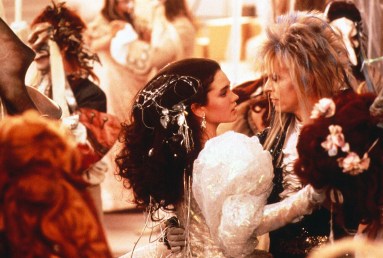
I was really pleased when the next day Time Out Music described listening to the new album as “Exploring Bowies goblin filled Labyrinth” making a connection with my most favourite film in the whole world.

Sarah and Jareth dancing to All Eyes...

Sarah and Jareth dancing to All Eyes…

In regard to the future of music, a tweet I noticed did make me laugh –  “Everything Everything, Foals, Delphic & Post War Years have all released albums in the last month. An electro indie band conspiracy?”.

No it isn’t a conspiracy, welcome (at last) to this generations music. Goodbye empty pop and rock.

By Natasha Steer

@natashasteer

Every picture tells a story and every story paints a picture – by Jane Ayres

Editorials
Beware of the Horse 4 (1)

Klaus Hartleben

We are drawn to images (excuse the pun!). People respond more readily to images than words.  They have a more immediate impact on the emotions.  They transcend language and literacy.

As writers, we are using words to create the images we want to evoke, the internal cinematic experience.

A bookshop (or Amazon page) provides a rich gallery of myriad images from which we can make a selection.  If we are attracted to the book cover, we pick up (or click on) the book.  Then we read some words – the book blurb – before making a decision on whether to sample more words.

The importance of the cover image cannot be overestimated.  Somehow, it has to capture the flavour, the essence, of the story within a relatively small space frame.  I wonder if designers realise the major factor they play in the initial success of a new book.

I love working with a designer and am thrilled with the images Medway-based Klaus Hartleben has produced for my book covers.  The internet has also brought me into contact with some wonderful artists and illustrators I would never otherwise have met, and in 2013 I hope to commission some original illustrations as part of the design, which is really exciting.

The Book Designer invites entries for its monthly e-book cover design awards and I would urge any indie authors and designers to submit work for feedback.  You get to see a range of diverse designs which is inspiring and stimulating.

e-Book Cover Design Awards, November 2012

Interesting how much I favour clean lines, bold powerful images, and neat uncluttered designs, yet in real life I’m messy and untidy.  Or maybe that’s why I appreciate clarity in art!  The psychology of what attracts us and the reasoning behind it is endlessly fascinating.

To find out more about Jane’s publishing experiences, go to her blog www.janeayres.blogspot.co.uk

Her recent e-book, Beware of the Horse, is available from Amazon.

The No. 1 Habit of Highly Creative People – By Leo Babauta

Editorials

462px-Croce-Mozart-Detail

The No. 1 Habit of Highly Creative People

“In order to be open to creativity, one must have the capacity for contructive use of solitude. One must overcome the fear of being alone.”~Rollo May

Post written by Leo Babauta.

Creativity is a nebulous, murky topic that fascinates me endlessly — how does it work? What habits to creative people do that makes them so successful at creativity?

I’ve reflected on my own creative habits, but decided I’d look at the habits that others consider important to their creativity. I picked a handful of creatives, almost at random — there are so many that picking the best would be impossible, so I just picked some that I admire, who came to mind when I thought of the word “creative”.

This was going to be a list of their creative habits … but in reviewing their lists, and my own habits, I found one that stood out. And it stands out if you review the habits and quotes from great creative people in history.

It’s the Most Important Habit when it comes to creativity.

After you read the No. 1 habit, please scroll down and read the No. 2 habit — they might seem contradictory but in my experience, you can’t really hit your creative stride until you find a way to balance both habits.

The No. 1 Creativity Habit

In a word: solitude.

Creativity flourishes in solitude. With quiet, you can hear your thoughts, you can reach deep within yourself, you can focus.

Of course, there are lots of ways to find this solitude. Let’s listen to a few of the creative people I talked to or researched:

Felicia Day – wonderful actress perhaps best known for her awesome awesome work on Dr. Horrible’s Sing-along Blog, Buffy the Vampire Slayer, and The Guild.

I was thrilled when she replied to my email asking about her creative habits. One of the things she said: she makes “sure to be creative first thing in the morning, before doing anything for the outside world, really sets the day up for me. It makes it feel that CREATING is my job, not answering emails.”

Ali Edwards – an author, designer, and leading authority on scrapbooking.

I was honored with a response from Ali as well. One of her top habits wasn’t exactly solitude, but is related: “Do nothing. I have a habit of welcoming time away from my creative work. For me this is serious life-recharging time where my only responsibility is to just be Mom & Wife & Me. Doing nothing has a way of synthesizing what is really important in my life and in my work and inspires me beyond measure. When I come back to work I am better equipped to weed out the non-essential stuff and focus on the things I most want to express creatively.”

Chase Jarvis – an award-winning photographer.

Chase also kindly responded with several of his key creativity habits — see more great ones at the bottom of this post. But here’s one that I loved: “Find Quiet. Creativity sometimes washes over me during times of intense focus and craziness of work, but more often I get whacked by the creative stick when I’ve got time in my schedule. And since my schedule is a crazy one and almost always fills up if I’m just “living”, I tend to carve out little retreats for myself. I get some good thinking and re-charge time during vacations, or on airplanes, but the retreats are more focused on thinking about creative problems that I’m wanting to solve. That’s why I intentionally carve time out. I make room for creativity. Intentionally. The best example of what I mean by a retreat is a weekend at my family’s cabin. It’s a 90 minute drive from my house on the coast. There are few distractions. Just a rocky beach and a cabin from the 60′s with wood paneling and shag carpet. I go for walks, hikes, naps. I read. I did get an internet signal put in there to stay connected if I need it. But the gist is QUIET. Let there be space for creativity to fill your brain.”

Maciej Cegłowski – painter, programmer, excellent writer.

Maciej is one of my favorite bloggers, and responded to my email with a classically short answer that to me, embodies a beautiful way to find solitude.

What habit helps his creativity?

Maciej replied: “Running up hills!”

Leo Babauta: OK, I wasn’t going to talk about myself in this post, but I thought I should share some of my previous thoughts.

The best art is created in solitude, for good reason: it’s only when we are alone that we can reach into ourselves and find truth, beauty, soul. Some of the most famous philosophers took daily walks, and it was on these walks that they found their deepest thoughts.

My best writing, and in fact the best of anything I’ve done, was created in solitude.

Just a few of the benefits I’ve found from solitude:

  • time for thought
  • in being alone, we get to know ourselves
  • we face our demons, and deal with them
  • space to create
  • space to unwind, and find peace
  • time to reflect on what we’ve done, and learn from it
  • isolation from the influences of other helps us to find our own voice
  • quiet helps us to appreciate the smaller things that get lost in the roar

Read morethe lost art of solitude.

The Greats on Solitude

Of course, many other creative people have believed in the habit of solitude. I’ve collected a small but influential sample here. There are many more examples.

Wolfgang Amadeus Mozart – prolific and influential composer of the Classical era. He composed over 600 works, many acknowledged as pinnacles of symphonic, concertante, chamber, piano, operatic, and choral music. He is among the most enduringly popular of classical composers.

Mozart: “When I am, as it were, completely myself, entirely alone, and of good cheer–say, traveling in a carriage or walking after a good meal or during the night when I cannot sleep–it is on such occasions that my ideas flow best and most abundantly.”

Albert Einstein – theoretical physicist, philosopher and author who is widely regarded as one of the most influential and best known scientists and intellectuals of all time. He is often regarded as the father of modern physics.

Einstein: “On the other hand, although I have a regular work schedule, I take time to go for long walks on the beach so that I can listen to what is going on inside my head. If my work isn’t going well, I lie down in the middle of a workday and gaze at the ceiling while I listen and visualize what goes on in my imagination.”

Franz Kafka – one of the most influential writers of the 20th century. Novelist and writer of short stories whose works came to be regarded as one of the major achievements of 20th century literature.

Kafka: “You need not leave your room. Remain sitting at your table and listen. You need not even listen, simply wait, just learn to become quiet, and still, and solitary. The world will freely offer itself to you to be unmasked. It has no choice; it will roll in ecstasy at your feet.”

Nikola Tesla – inventor, one of the most important contributors to the birth of commercial electricity, best known for his many revolutionary developments in the field of electromagnetism.

Tesla: “The mind is sharper and keener in seclusion and uninterrupted solitude. Originality thrives in seclusion free of outside influences beating upon us to cripple the creative mind. Be alone—that is the secret of invention: be alone, that is when ideas are born.”

Joseph Haydn: A life-long resident of Austria, Haydn spent much of his career as a court musician for the wealthy Hungarian aristocratic Esterházy family on their remote estate. Isolated from other composers and trends in music until the later part of his long life, he was, as he put it, “forced to become original”

Johann Wolfgang von Goethe – German writer and polymath. Goethe’s works span the fields of poetry, drama, literature, theology, philosophy, and science.

His magnum opus, lauded as one of the peaks of world literature, is the two-part drama Faust.

Goethe: “One can be instructed in society, one is inspired only in solitude.”

Pablo Picasso – Spanish painter best known for co-founding the Cubist movement and for the wide variety of styles embodied in his work. His revolutionary artistic accomplishments brought him universal renown and immense fortunes throughout his life, making him one of the best-known figures in twentieth century art.

Picasso: “Without great solitude no serious work is possible.”

Carl Sandburg – American writer and editor, best known for his poetry.

He won three Pulitzer Prizes, two for his poetry and another for a biography of Abraham Lincoln. H. L. Mencken called Carl Sandburg “indubitably an American in every pulse-beat.”

Sandburg: “One of the greatest necessities in America is to discover creative solitude.”

Thomas Mann – German novelist, short story writer, social critic, philanthropist, essayist, and 1929 Nobel Prize laureate, known for his series of highly symbolic and ironic epic novels and novellas, noted for their insight into the psychology of the artist and the intellectual.

Mann: “Solitude gives birth to the original in us, to beauty unfamiliar and perilous — to poetry.”

The No. 2 Creative Habit

While it might seem contradictory, the No. 2 habit when it comes to nurturing creativity: participation. This can come in many forms, but it requires connecting with others, being inspired by others, reading others, collaborating with others.

But how can you have both solitude and participation? They obviously have to come at different times. Finding the balance is key, of course, but it takes a conscious effort: this time is for solitude, and this time is for participation.

Why are they both important? We need inspiration from without, but we need creation from within.

A couple of the people I interviewed had habits that relate to this:

Chase Jarvis: “Devour Popular Culture. Consuming the works of others inspires me. And it’s not just museums and the “establishment”. I devour magazines, books, street art, performances, music, etc. All things that make me think critically (and whimsically) about the world. You get the picture. Inspiration can come from anywhere.”

Ali Edwards: “Participate. My creative spirit is interested in documenting the wonderful everyday details of our lives. To really get to the heart of the matter I need to be fully participating in my life, in the interactions with my kids and husband and family and friends. If I am just going through the motions or wishing away the present moment for “the next thing” I am missing the blessing of right now. My creativity requires the habit of active participation and daily attention to detail.”

Other Creative Habits

There are other habits than those top two, of course, that can nourish creativity. Some other good ones:

Felicia Day: “When I am most productive I am the most ruthless with my schedule. I will literally make a daily checklist with, “one hour gym”, “30 minutes of internet research,” and “drink 3 glasses of water” on it. For some reason being that disciplined creates a sense of control that I wouldn’t have otherwise, as a self-employed person, and I get the most out of the scheduled hours that I have for writing.”

Ali Edwards: “Take notes. I am a really good note-taker. It’s essential for me to write down my ideas when they come to mind…otherwise, poof, they disappear way too quickly as I move on to the next task (diaper changes, wiping noses, tending to the stuff of life). I use my phone, my computer, and a moleskine notebook to jot down thoughts and ideas and then I move them into Things every week or so.”

Chase Jarvis had a few more:

  • Live a creative life everyday. I very much believe in doing creative stuff everyday. For one, I take photos and videos almost everyday. Doesn’t matter the camera. I use my iPhone everyday. Just taking photos keeps me in a creative headspace. Hell, I play with my food and draw and doodle.
  • Moderate Expectations. Make it a habit not to judge yourself on your creative output. Sometimes your creativity is on fire. Great news. Other times, it’s not. It’s hard sometimes when you make art in a professional commercial capacity because you’re paid to be ‘ON’, but you’ll save yourself a lot of greif if you make it a habit to be cool to your psyche when your creative mojo isn’t firing on all pistons.
  • Shake Your Tree. When I’m starting to feel stale, I make a habit of getting into adventures. Break molds. Drive home from work a different way. Stir up my routine. I get active and shake my tree.
  • Find fun.  Doing what you love inspires you to be more creative.  Make time and space for having fun.  All work and no play makes Jane a dull girl.
  • Lastly, being creative means living a creative life.  Expect yourself to have one.  Believe you are creative. Know that you are. Make that the most important habit of all.

For more on creativity, read my Little But Useful Guide to Creativity.

“Creativity is essentially a lonely art. An even lonelier struggle. To some a blessing. To others a curse. It is in reality the ability to reach inside yourself and drag forth from your very soul an idea.” ~Lou Dorfsman


Article courtesy of http://zenhabits.net
How To Showcase Your Work – By Alice Stansfield

Editorials

Showcasing your work!

Over the last month I’ve been going through my university interview, nerve-wracking as they are I found stress can be avoided through preparation, creative preparation that is. For example I create mind maps and tables of strengths and weakness of each university I’d visited to help me decide where to apply and once apply I worked through each prospectus with a pack of sticky notes highlighting things to ask about and what I think they might ask me about, what they are looking for and so on.

Then came the actual interviews. The majority of my interviews didn’t actually ask me to bring anything in particular surprisingly, but being a Creative I wanted to show them what I’m capable of. If you are interested, which I’m guessing you are if you’ve read this far, I am applying for Film and TV Production courses mainly in the South, and so I presented to them a showreel and portfolio. I am not claiming I am an expert with making a showreel, portfolio or taking part in interviews, but I wish to share my tips which I hope are helpful to at least one person. (So far out of 5 of the university I have applied for I have had offers from 3 of them and the other two I haven’t heard from since I interviewed there today and one yesterday.)

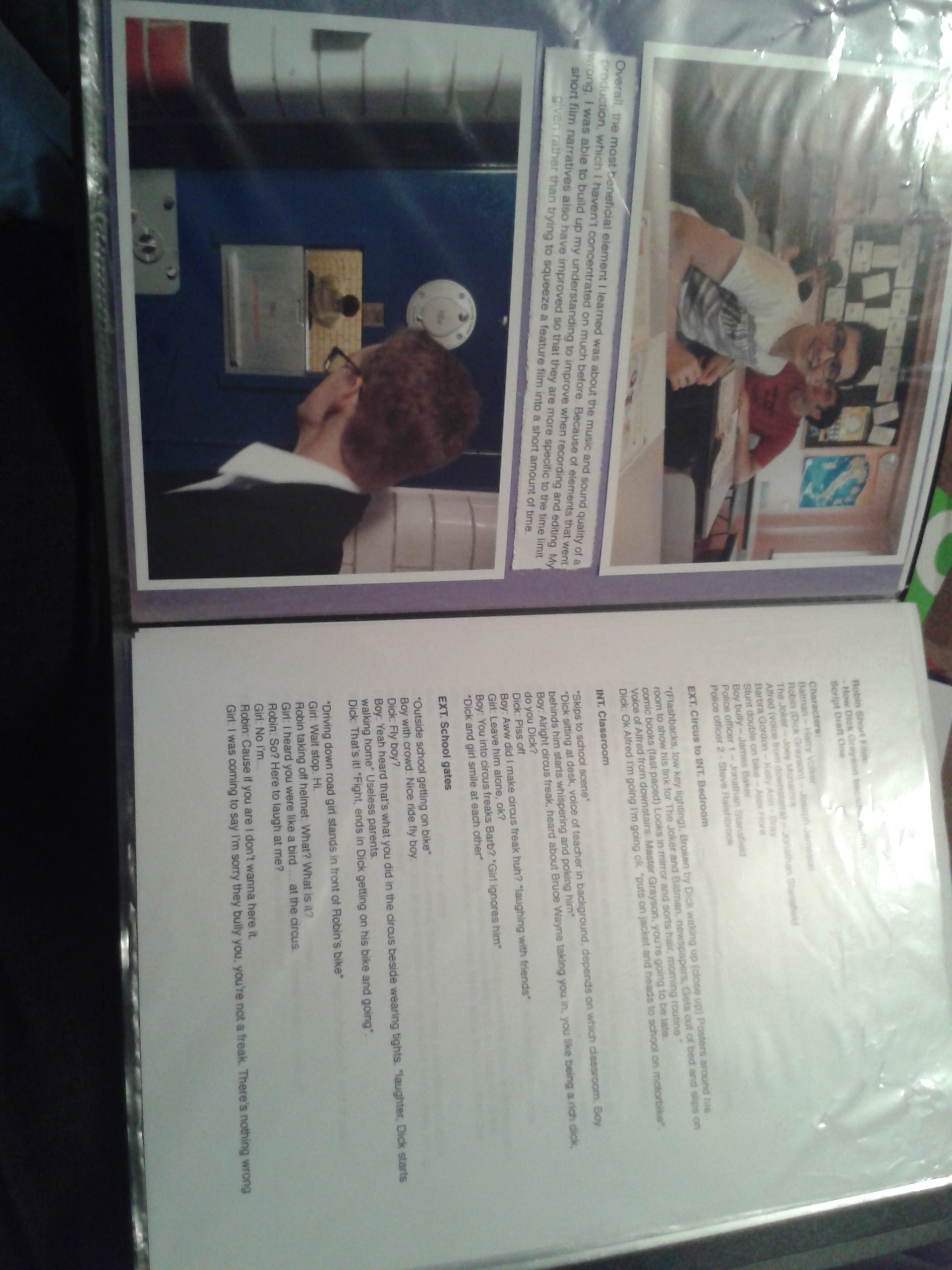
20130201_221324 20130201_221411 20130201_221338 Portfoloio

PORTFOLIO: The majority of my portfolio was made up of extra curriculum projects, either my YouTube or work experience so I thought it was crucial to include to show my extra work and dedication. However, even with out these extras I still could have found ways to have something to talk about. My portfolio was mainly a ‘show and tell’ tool. For example I was asked what sort of films I make so I turned to the page where I received an A* for a Batman and Robin filmed I’d made, followed by music videos and a web-series. I didn’t include all my projects, instead just included a range of genres to show how I expose myself as much as possible, and the importance of experimenting. When I was asked about my work experience I’d mainly included pictures to show me working that I’d asked other people to take on the day and so on.

My tops tips would be:

1. Include extras, not something you HAD to do.

2.Don’t include everything you’ve ever done, concentrate on including a variety.

3.Limit your writing, use it as more of a flick through and point to get the ideas across.

SHOWREEL: Looking at over 40 hours worth of my old footage I went through outtakes, to shots I don’t remember shooting, home videos all the way back to stuff I shot on my first Nokia. Eventually I decided it was taking TOO LONG and I wasn’t being strict enough of myself. Most the time I found a shot of my best friend who looked so sweet in a particular shot, but it told nothing of my filmmaking skill or script writing, therefore I had to learn to scrap what was useless to me. From work experience I have been told you are lucky if a producer watches 40 seconds of your work, so they recommended to me making a 60 second showreel that established quickly a range of projects then explained in more detail, depending on the genre you’re going for. I experimented through YouTube, of course my home! I made a 1:30minute showreel for anyone to watch and asked for feedback. I was told it was a good length but didn’t need certain shots and sound wasn’t very good, so I went back and edited. THIS WAS SO HELPFUL, I can’t recommended feedback more! Finally on my fourth draft I’d finished! I used royalty free music, my friend made music for me because I wasn’t sure what universities would think of me using particular songs and I wanted to be able to say that everything was from scratch and linked to me in some way, but if you don’t have a friend lovely enough to give up their time and create then I recommended this site for royalty free music: http://incompetech.com/music/royalty-free/

My tops tips would be:

1.Think of every aspect, sound/shots/editing and make sure it shows your best work. If one particular shot gives you hardly anything to talk about then scrap it.

2.Try not to have too much sound on it, for example don’t jumble lyrics of a song to your own dialogue because someone watching it may ask you to talk them through it and you want everything to be clear.

3.Create drafts, get feedback, improve, ALWAYS!

I wish you all luck with universities, jobs, ideas the lot and hope this was helpful to at least one person out there. Thanks for reading, please leave a comment or tweet me @HisLittleEmoo, because as you know I love feedback!

Writing, therapy and positive outcomes by Jane Ayres

Editorials
photo by Jane Ayres

photo by Jane Ayres

When I was younger, writing poetry which described and explored my state of mind during major depression may have saved me from a nervous breakdown.  Artists and writers can, and do,  use their art as a form of self-therapy. Reflective writing with a purpose, intentional or otherwise.

Writing is how I express myself.  I can struggle with words when I speak.  Writing everything down first provides the chance to ensure clarity.  I’ve been doing it all my life.  Fiction, non-fiction, copy-writing, blogging, emails, to do lists……So why am denying myself this proven therapeutic tool now? When I am still coming to terms with losing both my parents to pancreatic cancer in the space of 6 months. Burying the grief, the profound, deep sadness. The anger.  Why do I feel uncomfortable writing about it?

I don’t have children of my own.  Years ago, my maternal instincts found an outlet through caring for a special, adored young cat and when I lost him, I channelled my grief and helplessness into volunteering and fundraising for the Cats Protection League.  Eventually I was able to write about it. Over the past year, I’ve raised funds and tried to raise awareness of pancreatic cancer.  When I lose loved ones, I have a desperate need to find a positive outcome from all the tragedy.  It’s a useful way of focussing creative energy.

There is currently a high profile media campaign running which promotes the importance of cancer research.  What it doesn’t say is that not all cancers are equal.  To quote from the Pancreatic Cancer Research Fund:

“Pancreatic cancer has the lowest survival rate of all cancers – just 3% of those diagnosed survive for five years. It is also the only cancer that has seen no improvement in this figure over the last 40 years.

Overall, half of all those diagnosed with a cancer now survive for five years or more. For many cancers, five year survival rates have increased hugely since the 1970s. For breast cancer – where large amounts have been spent on research – five year survival rates have increased from 50% to 80%.

Yet despite its high death rate and lack of improvement in chances of survival, pancreatic cancer attracts little research funding in comparison with many other cancers.”

Although I’m not yet ready to write about my feelings,   I’m glad that I can use what I write as a tool to raise awareness of issues that concern me which relate to my bereavement.  So if this results in even one reader making a donation to, or getting involved with, these charities, then the words have done their job.

Links:  http://pancreaticcanceraction.org/    http://www.pcrf.org.uk/

On therapeutic writing:  http://www.lapidus.org.uk/about.php

Jane’s recent e-book, Coming Home, is available from Amazon, with all author royalties going to the charity Cats Protection.

https://www.amazon.co.uk/dp/B00AGZV9WM

www.janeayres.blogspot.co.uk

Play, dream, write by Jane Ayres

Editorials
IMG00249-20121028-1209

photo by Jane Ayres

On the bus to Tunbridge Wells today I became aware of a dad with his toddler sitting at the front of the upper deck, both father and son playing at being bus drivers, with their pretend steering wheels and pretend brakes, laughing and shrieking.  It made me smile and reminded me of my own childhood and the way that we create our own stories and roles through play.

We can become anyone. We can do anything.  Our imagination enables us to explore new worlds.

One of my favourite toys when I was a child comprised of a host of plastic farm animals. My model farm provided me with hours of fun. I made up stories and adventures for the world I had created, and my imagination enabled me to become the tiny plastic figure with pigtails and jodhpurs with the cute Shetland pony. I made choices about what happened to my characters and landscapes, controlling their destinies in a way that isn’t possible in reality.  Like being a storyteller.  And I thought of what playing had in common with writing and my reasons for writing, for creating stories.  I sometimes wonder where this need comes from, why engaging our imaginations is so important.

I used to daydream a great deal as a child. It was all practice for writing my stories. I’m still practising.

This is my last post of 2012 for Creatabot – here’s to a creative 2013!

To find out more about Jane’s publishing experiences, go to her blog www.janeayres.blogspot.co.uk

Her trilogy of Matty Horse and Pony Adventures books for pre-teens and teens (and nostalgic older readers) are available for kindle on Amazon.co.uk. All profits from these stories are going to Redwings Horse Sanctuary. 

So What Exactly IS ‘Art’? – by James Bovington

Editorials
(From Google)

(From Google)

I’ve been thinking about ‘art’ recently. It happens sometimes.

More specifically I’ve been trying to work out what ‘art’ is. Not necessarily ‘what is art?’ because that opens up the forum for people to claim a single house brick on a cushion is art. They’re very different questions, since one deals with individual pieces and asks ‘is this art?’ and the other questions the nature of the ephemeral wisps of nothing we happen to actually call ‘art’.

That is to say I’m questioning the aspect, not the components. Anyway;

A while ago I found a video on Youtube that made my heart sing. I posted a link to it on my Facebook with the addendum “If you ever, EVER feel the need to ask me what ‘art’ is;”

The video in question is here:

There’s something about that situation that is so beautiful that I don’t know where to put myself. I think part of that is the knowledge that for most of these people there really isn’t a real reason to be doing that, it’s just fun.

On a similar note; a few years ago there was a particularly cold winter and Times Square in New York City got quite a lot of snow in one evening. What erupted from that were not complaints and injury claims but a huge snowball fight. There were a number of photos posted online (you can find them with a quick Google of “Times Square snowball fight 2009”) and they showed a bunch of strangers lobbing frozen rain at each other. There was one particular photo (which I can’t seem to find now, despite my almost invincible Google-Fu. I wonder if that makes it more special.) of a young man, arm extended in mid- throw with a look of such joy on his face that it made me happy for days.

Is that art? I think it is. Not the photos themselves, but the act. A gigantic, spontaneous snowball fight in the middle of one of the busiest cities in the world is a beautiful thing, and to me ‘art’ is definitively “Anything Beautiful”. I’ve mentioned the only other definition of art I respect elsewhere on Creatabot. (Here, to be specific). To me, ‘art’ that exists only to annoy people isn’t art. If someone puts up a gallery of paintings of people being tortured just to provoke a reaction, that’s not art, it is provocation and anyone can do it; you just have to shout insults in a library to get the same effect. The effect being people realising that you’re a dickhead. The only difference is that the first dickhead has learned to paint and the second hasn’t.

Which leads me to the reason I was thinking about this; I’ve been quite ill for a couple of weeks, but that didn’t stop me travelling to London with some friends one day. I thought I was feeling better, but I wasn’t.

After a harrowing (but cheap) journey down we spent a long time wandering around. I don’t really remember it very well, due to being an idiot when I’m ill. So it was that I found myself at the Barbican, standing in a room with water pouring from the ceiling, in a patch of dryness that followed me around as I shuffled back and forth. I was in Random International’s Rain Room, and it was very interesting.

But is it art? I think so, mainly because it’s interesting. As far as I’m concerned ‘interesting’ and ‘beautiful’ are very often one and the same. I also think the fact that I was in a strange headspace helped it seem more surreal than perhaps it actually was.

So no, I haven’t really answered the question I posed in the title, but can you blame me? Art is a shifting, formless thing and beauty is so subjective that having a single term for it seems overly simplistic.

Essentially all we’ve learned here is that people being happy makes me happy.

Is that art?

James Bovington is a writer of many different things, although he’s confused as to whether any of it is ‘art’.

You can find him on Twitter at: @JBov or you can look at his blogs:

http://jbovington.wordpress.com AND/OR http://burndownthesun.tumblr.com

For the journey by Jane Ayres

Editorials
design Klaus Harteben

design Klaus Hartleben

So many great stories are about literal or spiritual journeys, in which the protagonist is changed by the process, whether she has experienced incredible dramatic adventures or pursued more reflective contemplation.  Journeys seem to be a recurrent theme in my writing.  More than 20 years ago, the first novel I had published, Wild Horse Island, was about a horse taken from his familiar environment, his subsequent quest to make his way home, against the odds, and the people whose lives he changes in the process.  Always in my Heart, which comes out next year, revisits this idea, but in a different setting and on a deeper level. I was dealing with a major bereavement at the time and, inevitably, this affected how I told the story.

After a life-changing few years, the theme of journeys is very much on my mind at present, and my recent book, Coming Home, explores familiar territory for me, although this time it’s about two Norwegian Forest cats who are accidentally separated from, and seek to be reunited with, their grieving owner, encountering a host of creatures on the way.

As a human being, we each undertake our own personal journeys, whether or not we decide to analyse the process.  Where do I want to end up on mine?  I don’t know the answer yet, although we all arrive at the same place ultimately.  What matters more, the journey or the destination?  For now, I find the act of motion, whether that is walking, running, or being transported in a machine, triggers off my imagination in a way that rarely happens if I am staring at my computer screen.

Travelling by train or car provides great creative space, if I am a driver or passenger, and ideas fire off unprompted as I eat up the miles. I recently re-read Rumblestrip by Woodrow Phoenix, a monochrome graphic book all about what happens when we get behind a steering wheel.  The layout cleverly simulates a car journey and as you read, you feel like you are on a virtual car journey. I sometimes dream that I’m driving a car, and, strangely, when I drive at night, I sometimes wonder if I am dreaming.  Woodrow Phoenix describes it perfectly:

“There is a dreamlike quality built into the experience of driving.  A car windshield is a big window.  And also a screen….locations unwind on the other side of this rectangular glass almost as they do on a movie screen….you sit cocooned in your cabin….everything outside your windows is contained, the rest of the world an arm’s length away…..you glide through location after location as if they were erected just for you to drive past.  Every journey is a narrative with you at the centre.”

As writers, each time we imagine, create and produce a story, we are embarking on a journey of discovery, which our readers continue and reinterpret, each word illuminating the path and teaching us, deliberately or unconsciously, about the human condition.

To find out more about Jane’s creative journey, check out www.janeayres.blogspot.co.uk

Her recent e-book, Coming Home, about cats, people and journeys, is available from Amazon, with all author royalties going to the charity Cats Protection. https://www.amazon.co.uk/dp/B00AGZV9WM


Rewriting, Editing and Patchwork Quilts by Jane Ayres

Editorials

Quilt cushion cover made by Mrs Brenda White. Photo by her niece Jane Ayres

Writing is hard.  Creating something from nothing, from the recesses of your imagination, can sometimes feel a bit like pulling teeth.  Your own.  But when you’ve overcome that painful first stage of the process and you have pages of words in some kind of structure, you can sit back and reflect.  Then start editing.

I love editing.  It’s fun.  It’s all about refining and sculpting the words until you have the perfect combination.

Rewriting, on the other hand, is different.  And for me this often comes after work has been submitted to a third party, such as an agent or publisher.  This is when you get feedback that indicates that some substantial work is required to improve the piece and make it acceptable for publication.  I always groan when this happens.  Rewriting can be like unpicking knitting.   And a bit like doing a cut and paste in your head.   A mental jigsaw puzzle.

It is especially tough when you might have to sacrifice that special sentence that you felt so pleased about because it no longer works, or rewrite – or even delete – the character you were so fond of.   Or restructure the first section of the book.   The thing is, each change has a knock-on effect for everything else in the story.  You might solve one problem, but create another.

But then, writing is all about problem solving, especially in fiction. You invent the characters and then set them into an imaginary landscape with a host of issues and situations that will change them and their lives.  But you do it with love.

I often think of writing a novel as a bit like creating a patchwork quilt.  You have the pattern and you have selected the fabric of your story, and now you have to patiently connect everything together, piece by piece, blocking and layering the colours and textures of your characters and their journeys, until you have created a beautiful, unique work of art.

To find out more about Jane’s publishing experiences, go to her blog www.janeayres.blogspot.co.uk

Her trilogy of Matty Horse and Pony Adventures books for pre-teens and teens (and nostalgic older readers) are available as ebooks on Amazon.com and Amazon.co.uk. All profits from these stories are going to Redwings Horse Sanctuary. 

Matty and the Racehorse Rescue is FREE TO DOWNLOAD from 23rd-27th November!

http://www.amazon.co.uk/Matty-Problem-Ponies-Adventures-ebook/dp/B0094KJEVI/

‘Creativity, Productivity and Time Management’ by George Langridge

Editorials

To me, using technology to boost my productivity is almost everything. I’ve spent almost two and a half years searching for a practical, cost free (or very cheap) method of managing my time, boosting my productivity and being creative. I think I have cracked it.

As a student and creative, trying to juggle time to fit everything in, staying creative and being productive is a big task. Since getting my MacBook Pro, I have used nearly every application I could find to see is it could keep me productive and creative. Now, I use a variety of applications, services and methods.

iCal

Versatile, multi-tasking and simple.

 iCal/Calender [Free]

I’ve found that the ability to have multiple email accounts with their individual tasks, events and labels is really handy. I can see when I am due to go to college, work experience or out on shoot. I can also see when things are due, when I need to see family/friends and remember birthday. If you have to manage a company or group – that has it’s own email – you can see what everyone else should be doing or more likely, what they should be doing. You also have the ability to attach notes, files and locations to the event.

Quick search

Spotlight [Free]

Spotlight search is one of the most helpful tools on the mac, you have the ability to find documents, contacts, events, applications and much more. I use this tool to quickly open applications and recent files, Spotlight search learns what you search for the most. For example, if I search the letter Spotlight will put Twitter as the top hit, the same applies to Final Cut Pro when I start to type fin… which makes finding things a lot easier. It may only seem to save a matter of seconds, but over the course of one days worth of use you save about half an hour at least. Spotlight is also configurable to search (or not search) user defined files and drives.

Evernote, Mindnode and Pocket.

Evernote, MindNode Lite and Pocket [Free]

These three applications, to me are my creative trio. Evernote lets you store notes that are synced with as many desktop and mobile devices that I want, similar to notes on iCloud, except with more options, more platforms and quicker syncing. MindNode is an application that lets you quickly create mind maps with no limit to the amount of nodes or characters at all. Pocket is a read later service, however I use it like I -occasionally- Pinterest, to save interesting articles, awesome designs and photography. When they’re used together they really help with creativity, and productivity for that matter.

Wunderlist.

Wunderlist [Free]

Wunderlist is a great productivity application, which syncs across multiple devices on multiple platforms. This application, unlike reminders, lets you add notes, due dates and gives you the ability to easily create lists. I use Wunderlist to help organise work loads, tasks and I have a list of things to buy/do for my house/bedroom. Lists can be shared between as many or few people as you wish, they get to see deadlines, notes and whether or not you have stared  (prioritised) a certain task. I do however, wish that this had integration for notification center and iCal/Calender, the option to attach files would be great too. I am however, told (via a tweet) that these three things are being developed as you read this, or are due to be developed very soon.

Geektool, pardon the back-up.

Geektool [Free]

As many people that follow me on Twitter/Facebook know, I absolutely love Geektool. The simple ability to add the time, date, system specs and more to your desktop is just unbelievable helpful. You can add so many aspects to your desktop via Geeklets and scripts which are readily available on the internet and fairly simple to write yourself. My Geektool set up consists of [left to right]; system information, random/chosen quotes to boost inspiration, time, day, date and month. This is a fairly basic set up, I’ve seen some that have; calender information, RSS feeds, weather and iTunes information.

Google Drive and Dropbox.

Google Drive and Dropbox [Free – standard storage option]

Google Drive and Dropbox, to me, are extremely helpful and essential applications/services. I use Google Drive to easily share and edit files with different people, this allows me to see what they’ve changed, as well as giving me the ability to change multiple options depending on who the file is being shared with. I use Dropbox to store templates, Final Cut Pro/Avid/Adobe workspace files and other files I use across different devices on a daily basis. I absolutely love these services and wish I could afford extra storage space for both Dropbox and Google Drive. Definitely recommend these services.

Labels in the Finder.

Labels in the Finder

Using colour labels within the Finder is nothing new for any mac user. However, in my opinion not usually for the right reasons. I don’t think that occasionally labeling a folder red, in order to grab your attention half way through a project is at all a good use of this powerful tool. As you can see I have labeled all of the possible colours, and I label everything -seems a little obsessive- which, at a glace lets me know which each folder and project is for.

These are just a few things I do to keep productive and creative. If you have any more ideas, comment, tweet or email me.

Twitter/Instagram: @georgelangridge

eMail: georgelangridge95@gmail.com

Featured Creative – Bryony Hacker – Visual Artist and Campaigner

Editorials, Featured Creatives

17 year old Bryony Hacker has just completed her Extended Project Qualification. So what topic did she choose to study? Make a short film, like someone I know; study how to make a bridge; write a very long essay about wars in History?

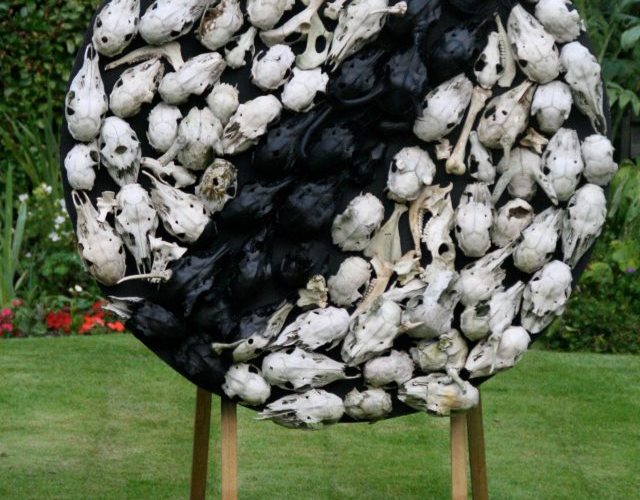
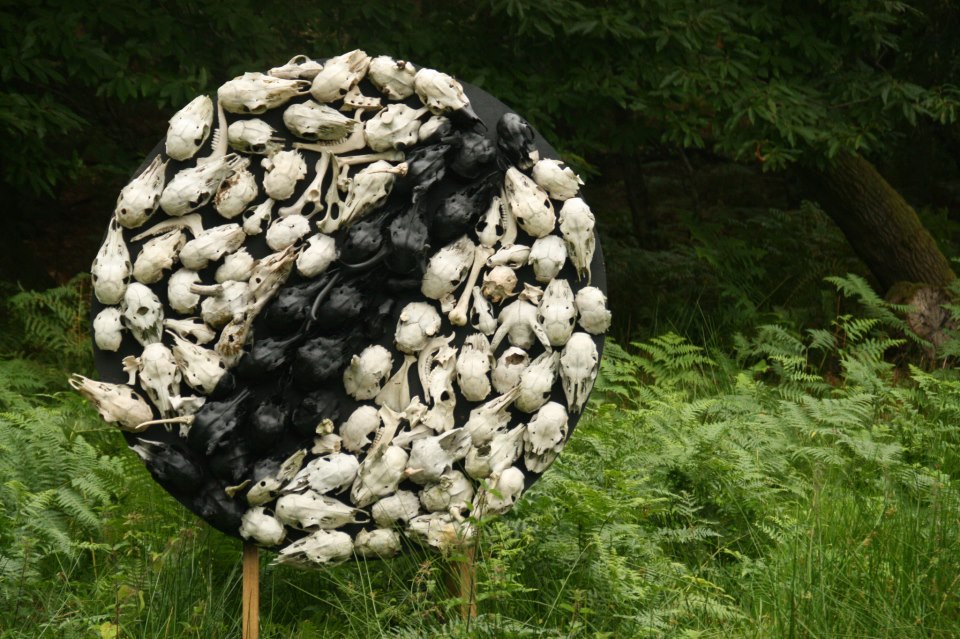
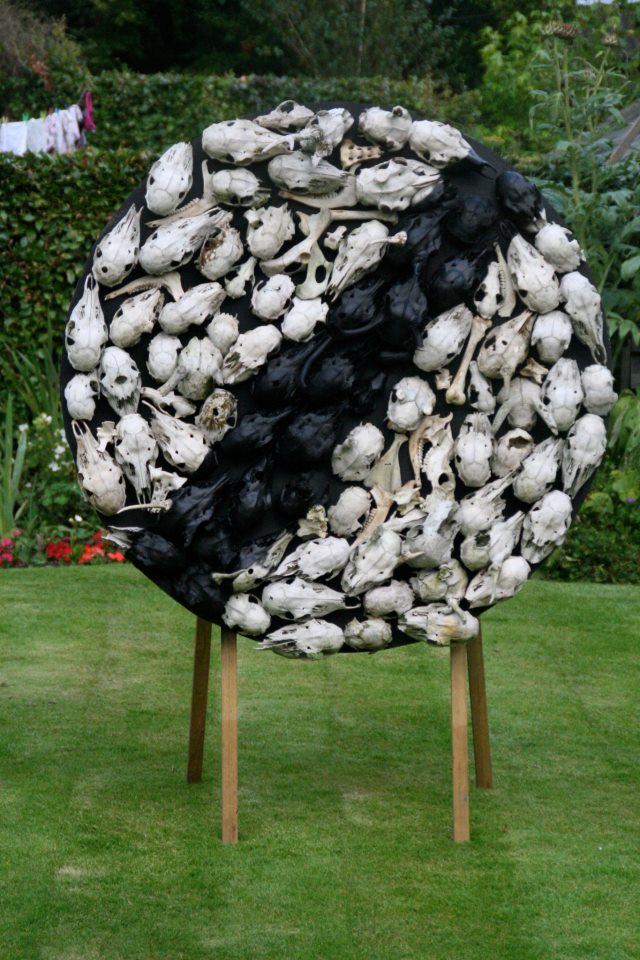
No to all of those actually. She created a National Speed Limit sign out of Deer Skulls that she had collected on the side of her road. This road is the A22 on Ashdown Forest. Her aim was to raise awareness about dangerous driving on this road towards deer. She targeted teenagers at the college who are learning to driving or already driving to talk about her issue.

Bryony currently studies art photography at college in Uckfield and is aiming to go on to Art Foundation next year. This project not only raise awareness, but allowed her to create a sculpture with her artistic skills.

I spoke to Bryony after her presentation to her fellow students about the project.

What inspired you to create your sculpture?

I live beside a road which has the most deer collisions on in the UK. It has around 300 deer that die yearly on the road due to car collisions. Human fatalities happen as well (about once a year), but most people don’t know the figures because every thing is ‘dealt with’ by the forest rangers and the police. I wanted to raise awareness of this, even if I had to do it in a very visual way. All the sculls found on the sculpture have been deer hit on the road literally on my doorstep.

How long did it take to collect skulls and make the sculpture?

My brother and I collected the skulls when we were little.. every few months from about the age of 7, we walked along the road with tesco bags. Every time we went we collected about 3 bags full, so I guess i’ve been collecting on and off for about 10 years. I didn’t use all of them in the sculpture! And I’d say it took about 10 hours in total.

You have much news coverage planned, for example the local news paper, is this helping to promote this message?

I am intending to be in 2 local newspapers in the next few months, and hopefully in time get onto the BBC news. I think this would be fantastic because then people all over the country would know about the danger, and would maybe take more care when crossing the road; instead of driving way over 60mph with no realisation of what could jump in front of them. When the media coverage is finished, I think it will be very memorable still to drivers on the road.


Although the project is finished, Bryony’s campaign has not. She is starting a petition to have the speed limit lowered on the road. If you wish to know more about how you can help please comment on this post or email aostansfield@hotmail.co.uk and I will contact Bryony directly.

Thank you for reading.
By Alice Stansfield your friendly neighbourhood vlogger: http://www.youtube.com/user/HisLittleEmo
Feel free to Tweet me if you have any questions or feedback:  @hislittleemoo
Email me for anything extra: aostansfield@hotmail.co.uk

The Harshest Deadline Ever Levied – By James Bovington

Editorials

(From Google)

I’m writing a novel.

I know, I know; who isn’t? Go into any overpriced coffee-delivery chain-pit in the world and you’ll be able to spot at least three people with Moleskine notebooks, or typing on Macs, who when prompted will spew words at you about their novel. About how it explores the deeper significance of caramel biscotti, or it’s about non-conventional love dodecahedrons in tribes of scholars living in log cabins in Alaska, and every character is called Jim, even the women, because conventional naming is just holding us back, man.

These people will usually be wearing tweed ironically or skinny jeans un-ironically and all of them will be plastered with that smug look that makes your rage-glands twitch. Some of them might even close their eyes as they describe a scene from their novel in great detail, like it’s transporting them to their own personal Nirvana and they can’t bear to look upon the real world while they frolic in it. This is your cue to punch them as hard as you can right in their awful neck, pour their mocha-frappe-London-fog-flat white-fuckwit-latte onto their Macbook (because it will be a Macbook) and run, howling, into the misty night.

Except in November, when you might just spot a nomadic tribe of Wrimos, bedecked in nothing but pieces of fruit; weary, harrowed eyes; frantic caffeine jitters and normal clothes.

‘Wrimos’ are what people refer to themselves as when they are participating in National Novel Writing Month, which I’ve mentioned before. (You can see it by clicking the second instance of the word ‘here’ in this sentence, here.)

So, as I say, I’m writing a novel, but far from taking me years to craft a pretentious masterwork with infinite layers of detail, none of them funny, I have precisely thirty days to write 50,000 words. Any less and I have not ‘won’, any longer and I have not ‘won’. I have one of the harshest deadlines ever levied on a person, and it’s self-inflicted. Not just by me, either; there are currently thousands of Wrimos busily scribbling or tapping away at their own 50,000 word minimum and at this exact point in time (which I suppose is in the past, from your perspective) there have been precisely 942,626,284 words logged by everyone combined. To put that into perspective, the entire Harry Potter series comprises some 1,084,958 words.

We are eight days into November.

It’s mind-boggling the amount of people who throw themselves at this challenge, and the enthusiasm with which they metaphorically flagellate themselves with this ridiculous deadline.

So far I’m 7,845 words in, which at this stage is ok but not great. The average by now is about 11,000 but I spent a weekend doing things with my friends and a day training someone at work (I essentially have to write at work, since it’s all I do during the week), which is three of my days spent not writing at all. A couple of days I wrote about 1000 words, some days nearer to 2000. I’m writing a near-future-sci-fi-murder-mystery. Not by conscious choice; it’s just that when I started writing my main character (a journalist. Write what you know.) found himself at a crime-scene and some facts didn’t click together properly. I thought I was going to be writing a pulp sci-fi drabble, all smooth chrome spaceships and laserguns and whathaveyou. I’ve ended up with a subcity slum under London, twenty minutes into the future in a subtly totalitarian police-state.

That’s the trouble with this kind of writing. There’s no time to force your story back onto the track you picked for it. It’s a brilliant exercise in compromise. For example, there’s a character who I intended to be throw-away, maybe two or three lines of dialogue, but she’s ended up building a nest in my head because I like her so much. I have resolved to kill her at some point, purely so she doesn’t derail the story. Her fate is sealed, as far as I can tell, but characters can be fickle.

There’s also the need to kill your inner editor. If a sentence is clunky or overwrought you have to leave it. There’s no time. You can’t listen to the voice in your head telling you something is stupid. I had to slip in a justification for something that happened pages later because I couldn’t go back. That’s another interesting exercise; you have to make things fit together coherently without being able to go back and rewrite sections. Murder-mystery lends itself to this, luckily: Agatha Christie used to just write the whole story and pick the least likely character to be the murderer, making all the evidence fit together right at the end.

The last thing I wanted to discuss before I stop writing this and go back to writing that is that I’ve gone bloody mental.

Only really in terms of writing (maybe you’d noticed?), but still it’s almost a problem. For example, I was just skimming my work and noticed I’d written the word ‘corners’ as ‘carners’, but instead of actually realising there was a problem I proceeded to read the rest of the paragraph giving the voice in my head an Irish accent.

I spent an entire paragraph explain how ‘regarding’ and ‘looking at’ are different.

I was physically unable to stop myself from writing an awful pun, then giggling at it like a schoolgirl.

One of my recent Tweets reads: ‘The Information Superhighway has no cycle-lane.’ I don’t remember why.

And

While typing the above sentence literally milliseconds ago I put my electronic cigarette down and now I have absolutely no idea where it is.

I’m not sure if I’m coming out of this unscathed, but at least I’m having fun.

That’s 978 words I could have typed for my novel. Oh god, the deadline is coming! It’s almost here!

By James Bovington, a writer of things.

ceramic horse by Jane Ayres

The Art of Wish Fulfilment by Jane Ayres

Editorials
ceramic horse by Jane Ayres

ceramic horse by Jane Ayres

When I was a child, I longed to have my own horse.  This was destined never to happen, because apart from living in an urban area, my parents couldn’t afford it.  So I created my own private horse world.

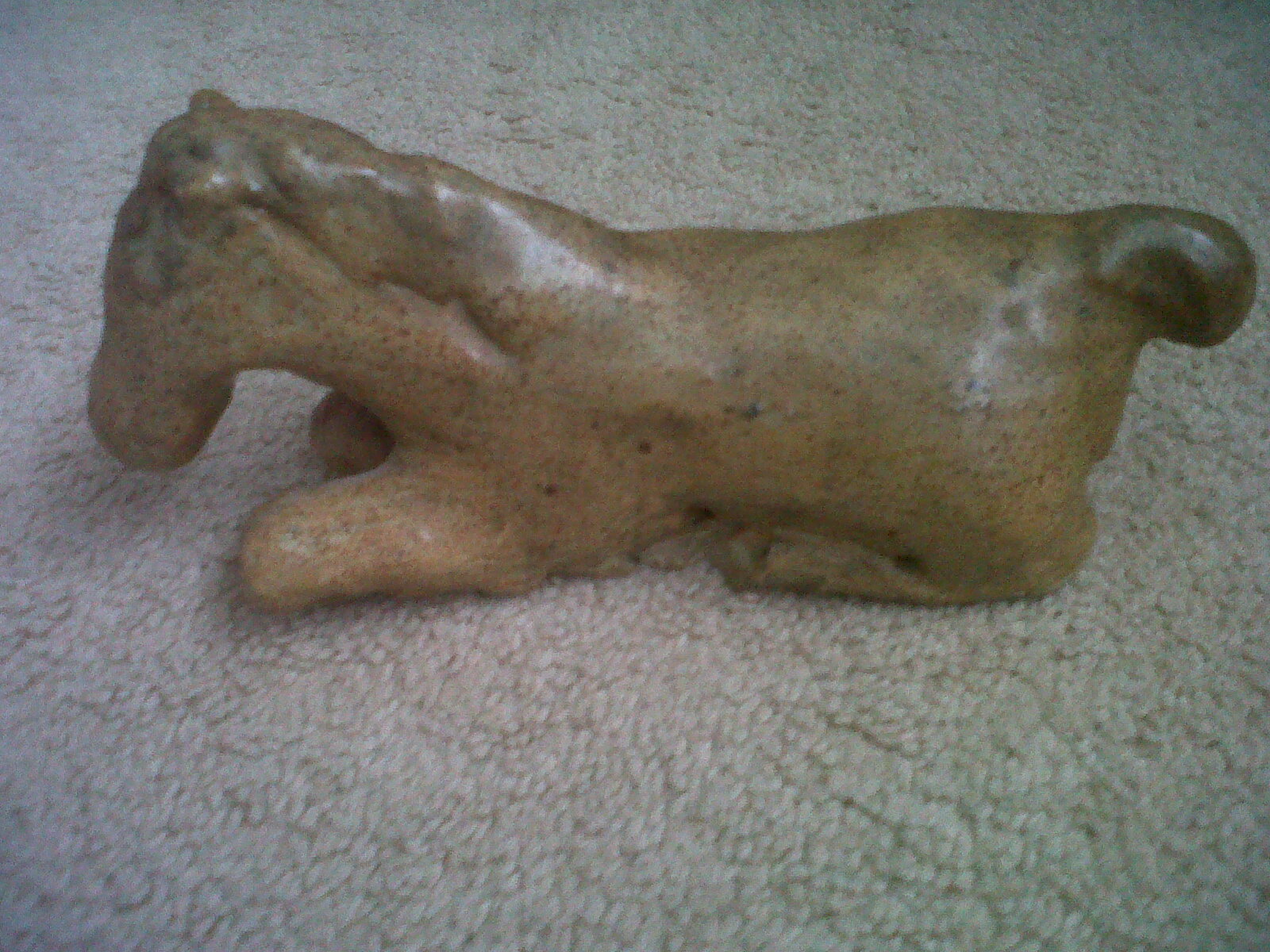
I drew horses in pencil and ink, mostly copied from photographs.  I collected pictures of horses from magazines and stuck them into a series of scrap books, often thinking up stories to go with the pictures.  In my art class at school, we were given a lump of clay to create a ceramic piece.  Obviously, mine became a horse of sorts.  I struggled with the legs, so the solution was to have the horse lying down.  His tail kept falling off, so he became a cob with a stubby tail.  He was glazed and taken home proudly to my mum.  He occupied my windowsill for years and I still have him, 40 years later.  Maybe he wasn’t exactly a work of art but he had been born from my imagination, moulded into shape and was mine.

Drawing horses, collecting pictures of them and making them from clay was not enough.  It was natural that as I developed my passion for creative writing, I would write stories about them.  I created the horses, characters and the experiences I desired through my fiction.  The ultimate wish fulfilment.

I would love to know how many other writers or artists create the fantasy world they would love to inhabit through their art.

To find out more about Jane’s publishing experiences, go to her blog www.janeayres.blogspot.co.uk

Her trilogy of Matty Horse and Pony Adventures books for pre-teens and teen (and nostalgic older readers) are available for Kindle on Amazon.com and Amazon.co.uk. All profits from these stories are going to Redwings Horse Sanctuary.

Matty and the Problem Ponies is FREE TO DOWNLOAD from 7th-11th November!

http://www.amazon.co.uk/Matty-Problem-Ponies-Adventures-ebook/dp/B0094KJEVI/

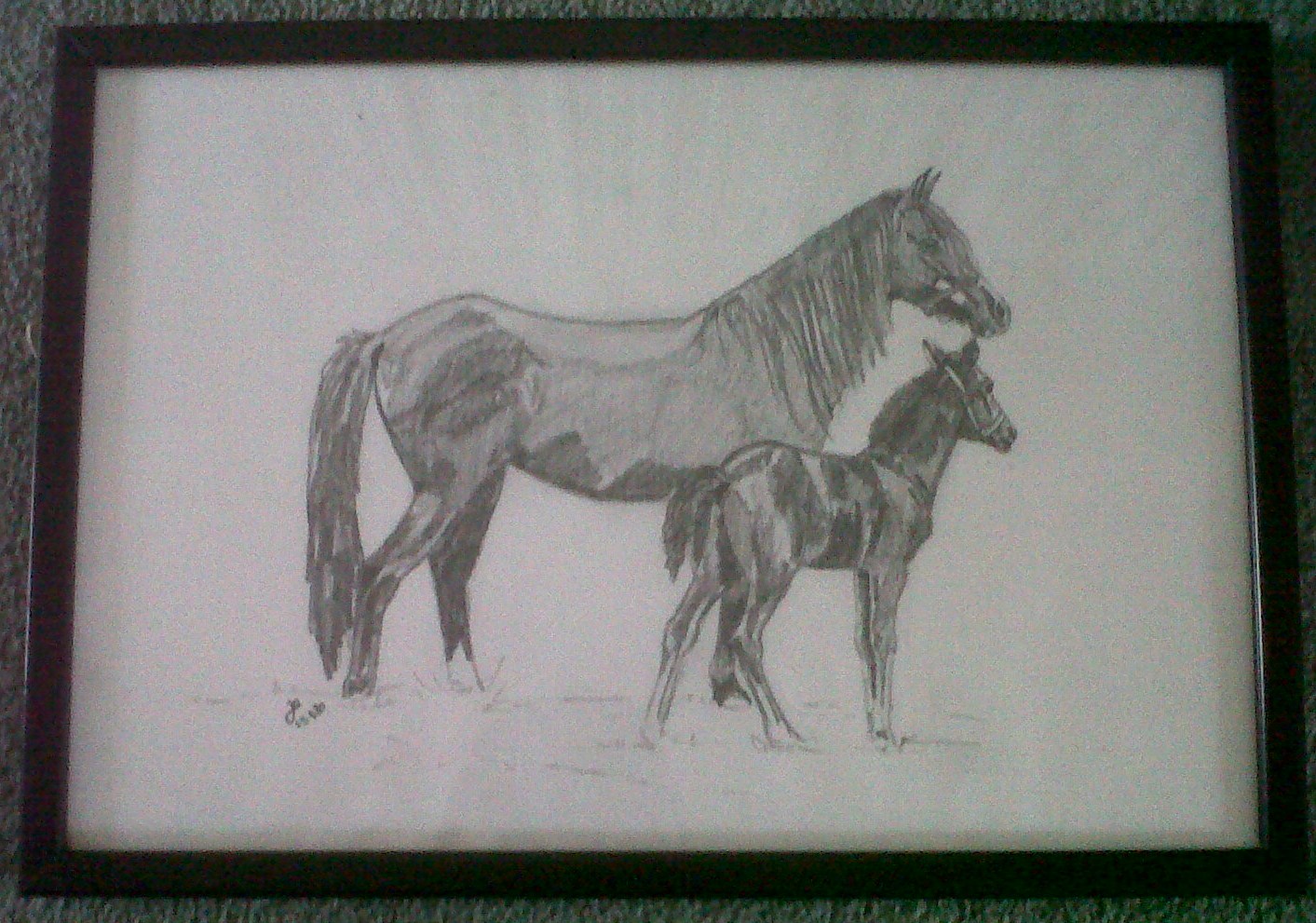
Mare and Foal by Jane Ayres – still having trouble with the feet!

Partition Crazy

Editorials

Lately I’ve been juggling a huge amount of files, from scratch disks to films to documents. A friend suggested I partition my hard drive to accommodate for use on; OS X, Windows and Linux as well as giving me -theoretically- separate disks/volumes for different file types, categories or recipients (ie. work for clients on one volume and personal work on another). Also, working on a mac, I want a drive to use as a time machine back-up.

Time Machine, looks futuristic.

I feel that, for both creatives, and techies alike this is a hot topic. I mean, do you multiply the amount of drives and lose space with each partition or keep your space and have an extensive folder system to navigate (if you’re as precious about your file and system organisation as I am) or do you just put your hand in your pocket, bite your lip and buy multiple external drives?

Partitioning a hard drive on any operating system is fairly easy, if you want to know how drop a comment below or tweet me. Although please note that when creating a partition in a hard drive, the drive will format itself so copy it all to your computers internal drive.

Disk utility for partitioning and repair.

I have had a play with partitioning an old 320gb USB 2.0 hard drive and here are my thoughts. My initial opinion was “why?” but after a while I began to find it extremely intuitive as I instantly knew which files where in which area and what types of files they would be, this meant it was a lot quicker to find what I wanted. I also tried partitioning based on what the files where (ie. personal, work, college, creatabot etc), I found this extremely helpful as it had a server/cloud like approach to finding files. I’m always pushing to increase my productivity, I found that this really does boost my productivity as it is so simple to find things. If like myself you work across different systems, formatting a partition to be compatible with Windows and the other partition Mac made life a lot easier when transferring files, code and other data. This means you don’t have to rely on services like; Dropbox (which is a great application, that I use daily), Google Drive and Droplr, which are a little slow for transferring files -this is not what they where designed for- but instead can just drag and drop between systems instantly (depending on file size).

Some of the downsides I found were; it took a few attempts to get the partition sizes right as different file types needed more space than others or different categories received more data than others, I could just make folders within the hard drive to separate things out that way which would mean I could rearrange things easily if space became an issue and it adds possibly unnecessary icons to your otherwise minimalist desktop (unless you’re a clutter offender).

Using a partitioned drive as a scratch disk is a really nifty way of staying organised although it does lead to a slight speed decrease (unless you’re running USB3.0, Firewire 800 or Thunderbolt where it is almost unnoticeable), I would recommend using hard drives as scratch disks for important edits as you can set each partition to collate certain data or duplicates. If you’re an ‘Avid’ user then a speedy partitioned hard drive is exceptionally helpful as you can set one partition as the linked volume, one as the linked drive/folder and another to store the rushes (obviously you’d back them up somewhere else as well, wouldn’t you?).

Avid link to volume.

Over all, I would definitely -if you have the space and a spare drive- recommend partitioning an external hard drive as I have found it boosts productivity and gives me the ability (when editing pictures or video) to save the edits, files and metadata on a separate drive to that of the all important RAW images or rushes.

Twitter/Instagram: @georgelangridge

Blinc Digital Arts Festival 2012

Creative and Art Events, Creative and Art News, Creative Communities and Inspiring Websites, Editorials


Photo: Craig Morrison and Joel Cockrill

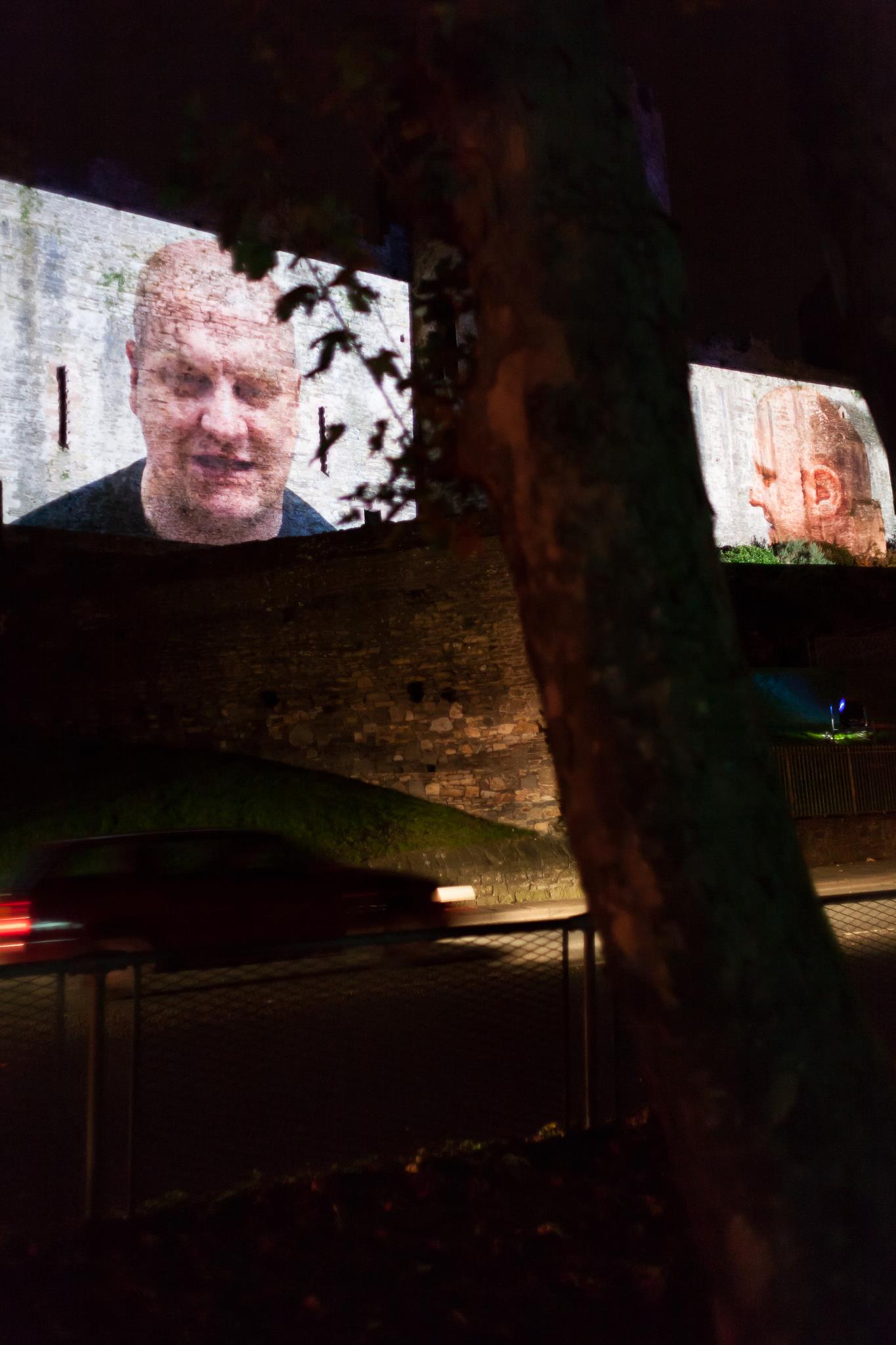
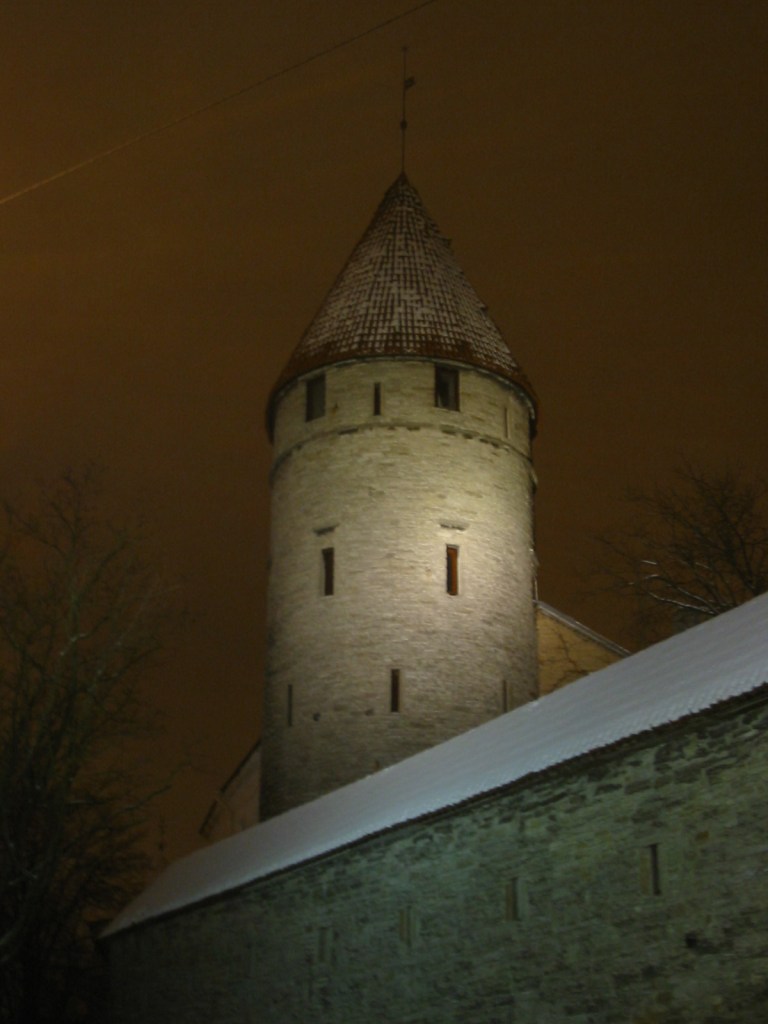
October 26th, 27th and 28th saw the Castle town of Conwy, North Wales, transformed into a giant piece of digital art, numerous buildings in the town became projection backdrops for digital, video, sound and light art created by a host of local and national artists.


The event is currently in its second year, and like last year coincided with Wales’ largest food festival. The event also paid homage to Alan Turing.

Famed for his mathematical intelligence Turing was fundamental to The Enigma Machine success in the 2nd World War, and considered one of the forefathers of modern computing.

To mark the centenary of his birth, Artist / Curators Craig Morrison and Joel Cockrill were commissioned by the Arts Council of Wales to make a significant light work dedicated to Alan Turing.

The piece, which is entitled ‘Thank you’, was installed in Conwy Castle. Two large lasers programmed with Rolling Spheres or ‘Hyperboloids’ positioned high above the town on the castle towers, beamed green lights that swept across the sea and the sky, the beams flickering at a frequency calculated using Morse Code projecting ‘Thank You’ towards the heavens.

To accompany the lasers a large scale white neon positioned on a plinth, identical in size to the Fourth Plinth in Trafalgar Square, so that Turing’s poetic epitaph can be read while the lasers pulse into the night sky behind.

Craig states that “The significance of the plinth is inherent to the piece. The Fourth Plinth celebrates all that is contemporary in the arts today. Alan Turing’s abstract mathematical achievements epitomize what the plinth represents and in some way is responsible for probably most of the artwork that is displayed. His fundamental work in computing has helped to shape what we see in contemporary life. His wartime work on codebreaking definitely contributed to the preservation of our freedom of expression.”


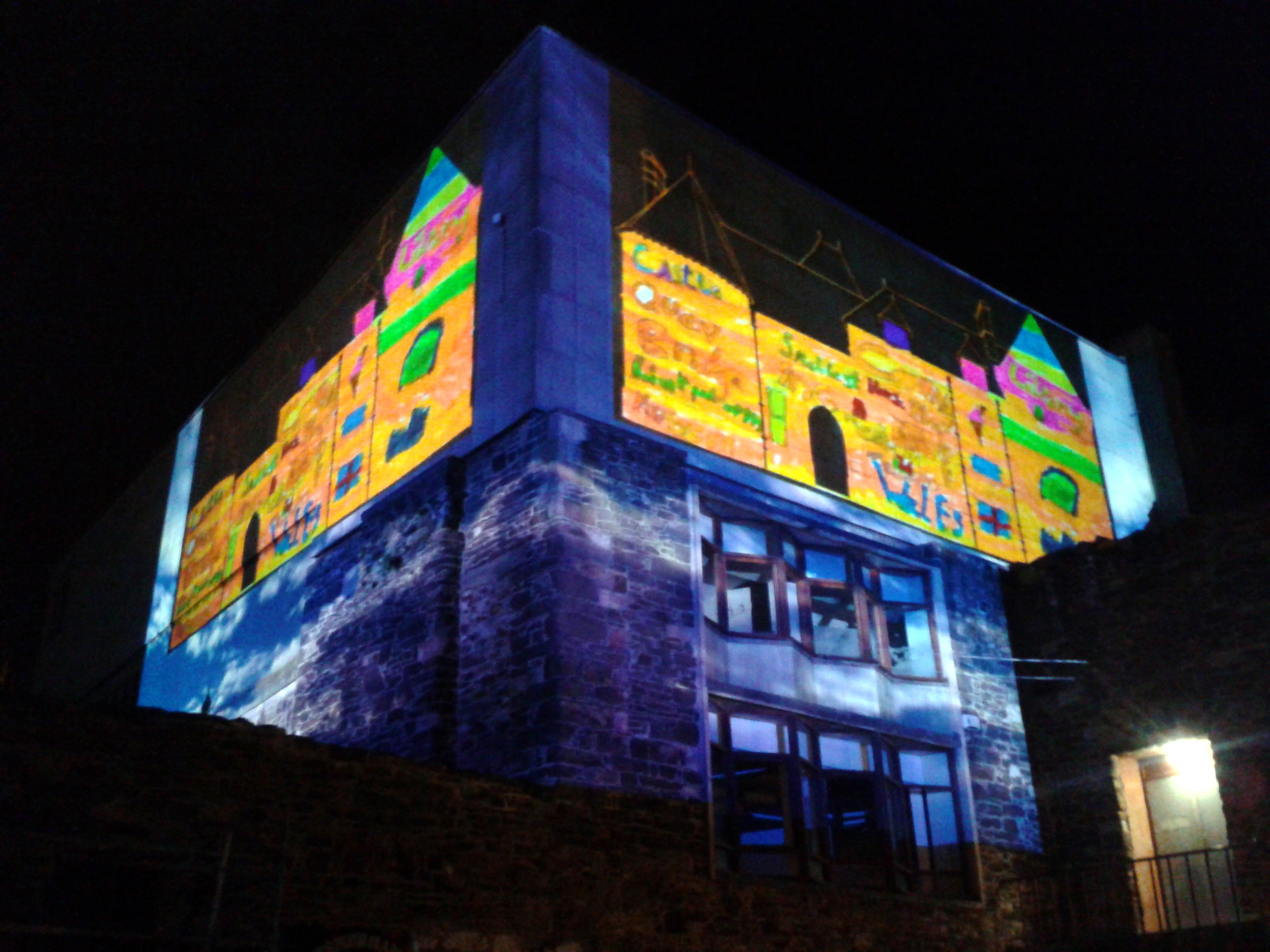
Children’s drawings of Conwy projected onto the Civic Centre


Other artists taking part responded to the town and its history, here’s a few videos from my favourites:


Neil Coombs:

Neil’s work explores surrealism and its relationship with every day life, the photomontage video creates a face using ordinary everyday objects we normally don’t notice or give any time too:


Wendy Leah Dawson:

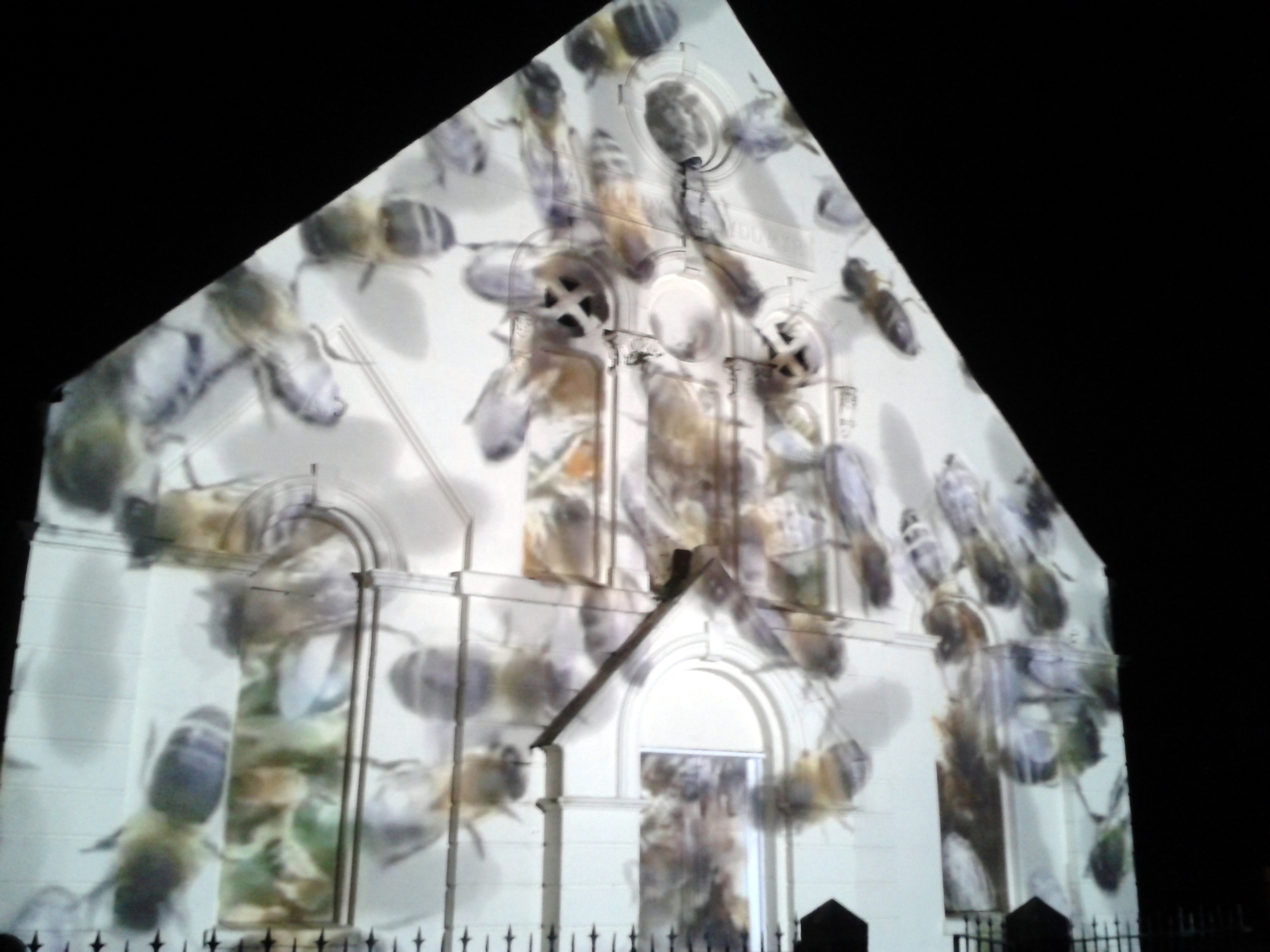
Wendy’s piece explored the swarm and hive mentality in bees, transforming an old chapel into a giant beehive, Wendy also paid homage to the towns historical bee keeping and honey traditions:


Alan Whitfield:

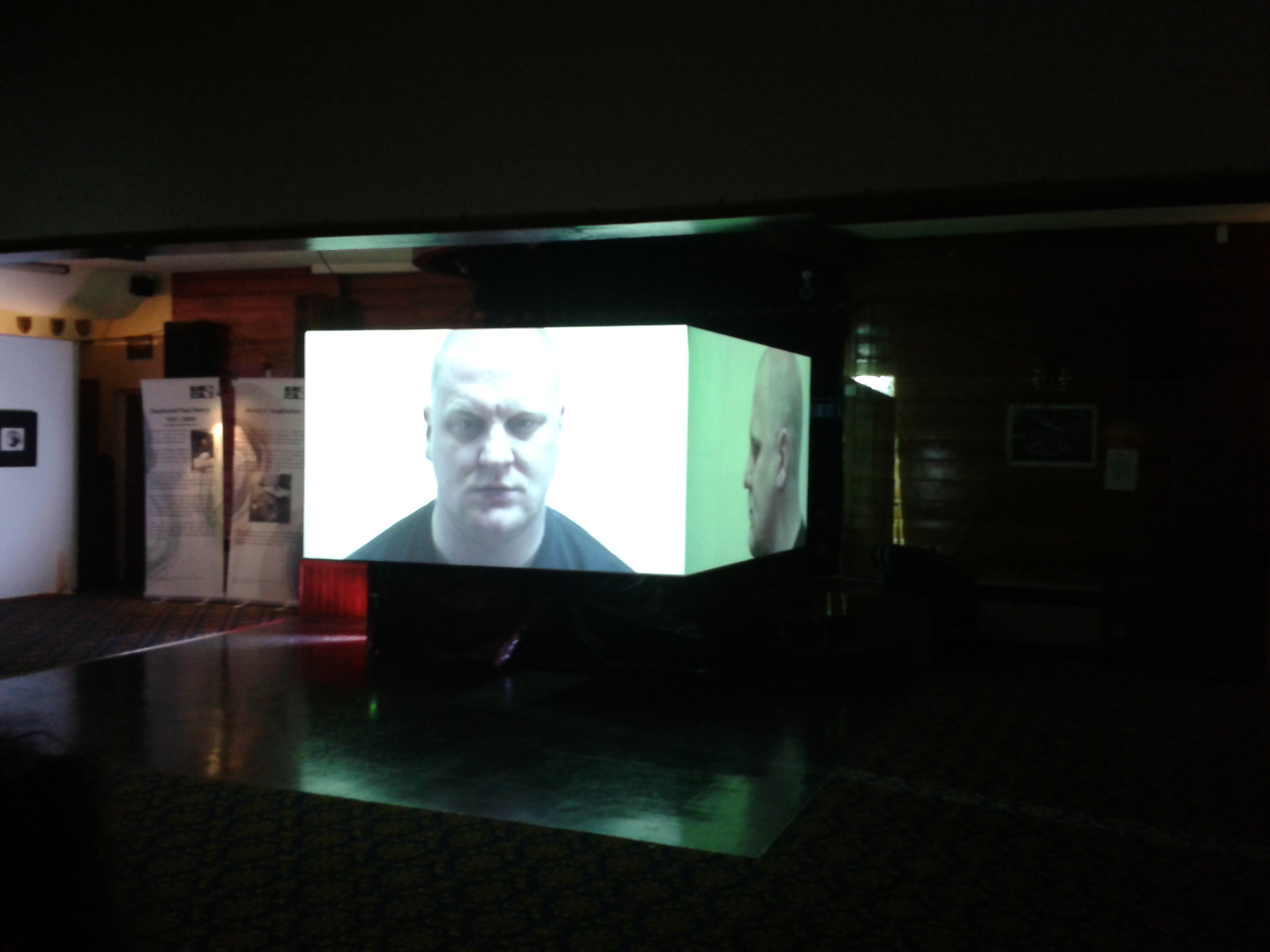
Alan’s video was projected onto the Castle – which was incredibly moving and overwhelming  – the scale, soundtrack and Alan’s presence made for a very powerful piece! Here’s the web version of the video and below that is a photograph by Roger Smith  of the projection on the Castle 


Elly Stringer + Alys Hughes:

I couldn’t find a version of Elly’s beautiful video entitled: ‘Hireath’ [loosely translates in English as ‘Longing’ – but there is no direct translation] that I could embed but she has put it up on her wonderful blog so head over there for a peek! The video was projected onto a bus outside of the British Legion, and watching it made me think of the time I spend daydreaming on the bus home from work, longing to get home, its a really evocative piece and beautifully made!


Alys, who performs in the video, each night completed a live dance performance in front of a projection inside the British Legion, which was stunning I have to say! Over the weekend they then repeated the performance this time in front of the projection on the castle – which unfortunately I missed 😦


It is a privilege to have such an amazing event right on my doorstep, and I count myself lucky to have seen it – especially considering the whole event was free! Well Done to all the team, organizers, helpers, Arts Council Wales, Cadw, Conwy County Council and of course the Artists involved!!


Garrets and Gatekeepers by Jane Ayres

Editorials

Photograph by Chris Ayres
http://scubabeer.uk.to/jalbum

More than 30 years ago I wrote an article for the now defunct Composer magazine called Starving in Garrets.  It was all about how painfully difficult it was for composers to get their work performed and heard, and even harder to make a living from writing music.  In many ways, I don’t believe things have really changed that much for artists and creatives. There is still that struggle for discoverability.

I’m a writer, primarily.  But I’m also a musician and have worked with contemporary composers.   I recently read some sobering statistics for writers.  For example, in 2011 there were 211,269 self-published titles and out of at least 1.2 million titles published by the entire industry over the course of a year, almost 80% sell fewer than 100 copies. (source: http://www.thebookdesigner.com/2012/09/7-book-marketing-mistakes/)

So how on earth do you get people’s attention? If you are a writer, it’s pretty tough.  If you are a composer, it’s even harder. We measure success by fame and celebrity status, regardless of quality.  So if you aren’t yet a “name” you are largely invisible.   How do you get the “gatekeepers” to listen to your music, or read your work? For anyone to take you seriously? If you are lucky, maybe 1 in 30 people you contact might reply and follow up your work. Many years ago, I decided to speculatively contact film production companies about one of my books.  I sent 35 emails with a pitch, had 2 replies, and this resulted in one meeting with a producer.  I was told this was a pretty good result!

The more successful you are, the busier you become.  Famous people have a whole raft of assistants (gatekeepers) which make it even harder to be heard.  Even a negative reply is a response, which acknowledges your existence.  You have been read, listened to.  Your creation is personal and precious and being ignored is far worse than rejection, though you may not agree.

But negotiating huge organisations like the BBC, for example, can be like scaling an impenetrable fortress.  If anyone knows how you manage to get a Proms commission I would love to hear from you.

Of course, the internet provides a global shop window on an unprecedented level.  Writers can publish without publishers, artists can create online galleries, composers and musicians can put their work on platforms like You Tube.  We can let the public judge.  As Natasha said in a previous post, artists don’t generally follow their calling for the money.  But they do need to be acknowledged, and better still, enjoyed.  They want to share their work.  That’s the whole point.
And so, with Xmas looming on the horizon, I’m including a recently discovered You Tube link to a moving performance of a haunting  Carol which a Canadian choir have used for their candlelit procession over the past 5 years.  The music was written by a UK composer who should be far better known.  Simply beautiful!

http://www.youtube.com/watch?v=SIyhg8e04cI

To find out more about Jane’s publishing experiences, go to her blogwww.janeayres.blogspot.co.uk

Her trilogy of Matty Horse and Pony Adventures books for pre-teens and teens (and nostalgic older readers!) are available for Kindle on Amazon.com and Amazon.co.uk. All profits from these stories are going to Redwings Horse Sanctuary.

Why Creatives Lose Their Mind : And How Not To – By Natasha Steer

Editorials

By Hugh MacLeod

I am no physiologist, let me get that straight. And I certainly know mental illness is a real and horrible sickness that affects thousands of people, often from birth. But I want to express my issues with this article:

http://www.bbc.co.uk/news/health-19959565 

 I am very creative, I do not have a mental health problems. I have friends who are creative, who do not have mental health problems. The issue in fact is this, yes, creatives are different. Creative people are biologically different, they are less inclined to fear standing out, being different and creating unique work. But…this argument also stands: EVERYONE HAS THE ABILITY TO BE CREATIVE. Which would therefore mean…yes…WE ALSO ALL HAVE THE ABILITY TO HAVE A MENTAL ILLNESS – should circumstances push it upon us.

The reason I wanted to write this is because I have close friends who are openly creative, and continue to struggle emotionally in this world. Society is not in a place in which it can support creative people, especially not creatives that are sensitive, which most are, because we are generally more passionate about helping to change the world we live in and help people.

Work is generally monotonous and people are not employed for their creativity, or used within employment to generate ideas with their creativity. The situation is made worse when an individual has health problems and again society does not support the idea of working part-time too well. The creative individual is left feeling useless, unfulfilled and not understood – and this generally leads to depression, which gets labeled as “mental illness”, which only makes society support the individual EVEN LESS, and can easily lead to long term mental health problems.

The solution? Creative people need to be supported and used more within society, they need to be able to freely express their creativity, and be employed by people who listen to their ideas. I think we all know how often that happens, and unfortunately I know the UK in particular in not supportive of creatives in the work place. They continue to struggle for work, get pushed beyond all limits when they are employed, and get shut down for thinking, creating and innovating. And what happens when that keeps happening to you? You feel depressed, useless, and give up.

One of the reasons I set up Creatabot is because I see this pattern happening over and over again, and then the media print articles like this saying that creativity is linked with mental illness, and I have to admit, it makes me quite angry, because society cannot see that often these creative people have been pushed away for being “different” and for being “over sensitive”.

The most hilarious part? Creativity is essential to exist, and to succeed. But funnily enough most of the decision makers in organisations continue to ignore this!

So my fellow creative people, before we all go crazy, I urge you to read the following and get the support you need to survive as a creative on the planet that is Earth, because we can make it a better place.

“The crea­tive per­son basi­cally has two kinds of jobs: One is the sexy, crea­tive kind. Second is the kind that pays the bills. Some­ti­mes the assign­ment covers both bases, but not often.” – Hugh MacLeod

An awesome book that encourages creatives to keep being creative and not take any nonsense, by Hugh MacLeod.

Based on the hit handmade zine THE ARTIST IN THE OFFICE is an inspirational, interactive book for any artist living in the real world. It encourages small acts of creativity and a simple shift of perspective to help readers bring their artistic selves into the workplace and thrive in all aspects of their lives. Readers are prompted to undertake a wide range of liberating activities, from the mundane to the sublime, that won’t put their nine to five job at risk.

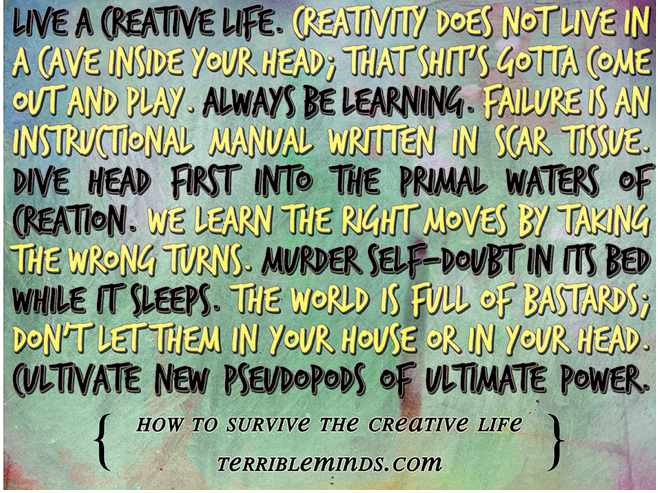
Creative people who spend no time at all with other creative people will start to feel profoundly alone. Connect with like-minded weirdos. Online. In-person. You are not a sad friendless little tugboat.

http://terribleminds.com/ramble/2012/08/07/25-ways-to-survive-as-a-creative-person/

“Seek out and surround yourself with POSITIVE people! Don’t let negative people get you down – it will dramatically alter the way you feel, work and live. We all know them; there is usually at least one person in our lives that is constantly moaning, and telling you that your latest idea won’t work. Creative people are sensitive people, therefore we tend to get sucked in by the negative ones, and before you know it, you’re feeling down yourself!” – Annabel Williams

http://tinyurl.com/d66lwhm

By Natasha Steer

@natashasteer

Writing in a Cupboard – by Jane Ayres

Editorials

Photo by Jane Ayres

A dear friend recently reminded me that I once wrote in a cupboard.

In a previous home I rented, space was very limited but the bedroom had a large walk-in wardrobe. Since my clothes only took up a fraction of the space, I realised my computer desk would fit in perfectly, with a stool tucked underneath and I could close the doors on it. This became my writing space, and very successful it was too. I was both prolific and productive during that time.

When I got a new pc with a small flat screen, I decided that maybe I would be even more productive if I relocated to the downstairs living space, wedging the desk between my piano keyboard and the TV. If I wanted to write, I only had to move from the sofa to the chair. One stride! Had to be even less effort than going up stairs? Big mistake, but it was months before I realised this. It was much harder to focus in this environment and too easy to leave the TV on and get distracted. My output dropped.

Yet, in the snug and encompassing cupboard I felt safe enough to write. When I feel protected, there is no need to worry about what is happening in the world around me – I can then safely enter the creative space. I realised that in order to write, I need to feel secure in the outer world before I can enter the inner.

To find out more about Jane’s publishing experiences, go to her blog http://www.janeayres.blogspot.co.uk

Her trilogy of Matty Horse and Pony Adventures books for pre-teens and teens (and nostalgic older readers!) are available for Kindle on Amazon.com and Amazon.co.uk. All profits from these stories are going to Redwings Horse Sanctuary.

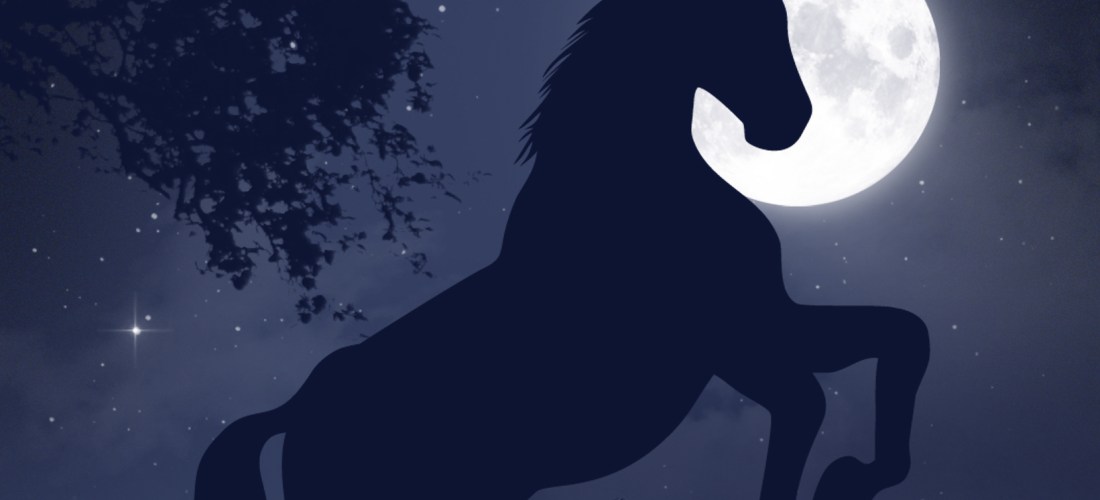
Matty and the Moonlight Horse is FREE to download until 23rd October 2012.

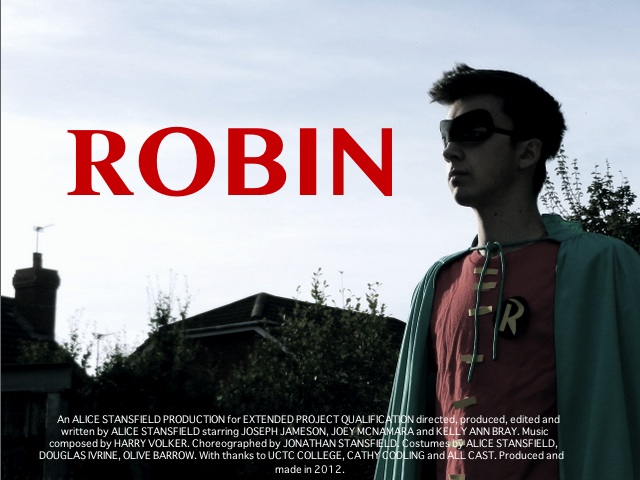
‘Robin’ – EPQ Short Film by Alice Stansfield (2012)

Editorials

5 months of planning, filming, editing and as of today releasing – I am exhausted!

An EPQ is an Extended Project Qualification, recommended to A level students to gain extra UCAS points and research into a topic they love. My title was ‘How have the ‘Batman’ comics been adapted to screen?’ I wanted to focus on specifically the narrative of a Batman comic and how Directors and Screenwriters adapted these original comics into the new films we have today, which almost rewrite the superhero genre. Within this project I made a log (written analysis documentation of all my research and shows my process of making my short film); an essay answering my question; presenting my EPQ (which I did today) and finally my short film.

I am a seventeen year old student who is dreaming and pursuing a career in film production. This film is not, I admit and repeat NOT my best work. Let me explain, I put my heart and soul into this project, but an EPQ is all about ‘process’ and ‘reflection’ therefore I needed to make mistakes to improve and show my thought process. The reason I have released my short film whilst I still feel doubts with it is because I have learnt from the issues included in it: audio quality and fight scenes for example are two areas I feel are major flaws, but now I can improve on them. Without doing this project I would not be able to create better videos in the future. I have future videos currently in editing and already I see a mass improvement.

My Christmas currently consisits of: a green screen, a filming production light set, final cut pro X and a boom mic. Yes, I have learnt how important professional equipment is. Although, I would like to pop out I spent no money on this project, there was no budget. Proof that you can make a film purely through connections (for example knowing someone who works at a local police station such as I did) and through trial and error.

Today I presented my EPQ to over twenty people at my college, and even manage to get a round of applause, which I much appreciated. Therefore today I felt was the right time to release my film to the people of the internet. At the top is my film and here are the links to other videos leading up to my short film. I really hope you enjoy and comments on YouTube as feedback are most appreciated.

http://www.youtube.com/playlist?list=PL1cizsL2GQbA0dJ7U6e60R-8_bA_Wn5Gs&feature=view_all

By Alice Stansfield your friendly neighbourhood vlogger: http://www.youtube.com/user/HisLittleEmo

Feel free to Tweet me if you have any questions or feedback:  @hislittleemoo

Email me for anything extra: aostansfield@hotmail.co.uk

Writing for Charity – by Jane Ayres

Editorials

cover design by Klaus Hartleben

“As a creative I can speak for most of us and say that often our motive is not money, it is to make a difference in the world.” Natasha Steer

This statement, from Natasha’s post on Networking Vs Making Friends, really struck a chord with me about why creatives create.

When I hear about best-selling authors making a fortune I envy the fact they can then give lots of money to charity.  Writing can be a powerful force for change.  But could it also offer a pathway to giving? I thought about how I could contribute more.   I could publish my work and donate any royalties to a charity I cared about. And, rashly, because of my motives, I disregarded a lot of practical advice, believing it didn’t apply.  Of course, whatever your reasons for publishing, if you want to raise money from it, then it is always a business decision, as I have since learned.

Having been traditionally published for over 30 years, and with 20 years plus experience in marketing, you would think I would have an awareness of what is involved.  That’s what I thought.  Funny how you can become blinkered…

I had decided to publish three of my backlist titles for the kindle to raise funds for Redwings Horse Sanctuary, who rescue and care for neglected, abandoned and abused horses and ponies.

I commissioned a professional Medway-based designer, Klaus Hartleben, to create my cover designs as this is the first thing that potential buyers will see.  For a digital book, Amazon is your shop window. Because I was donating all profits from my books to charity, I decided that using the Amazon “free” days to promote the books would defeat the object of the fundraising. ButI have been advised by several professionals that if Book 1 is free for a while (and readers enjoy it) they are more likely to buy the next two books in the series.  So later this month, I will be offering Book 1, Matty and the Moonlight Horse, free for 5 days.

Similarly, I ignored all the advice I read on pricing strategy as part of the marketing plan because the money was going to charity and I wanted to raise the maximum amount from each sale.  But comparing the prices I am charging to other similar titles, my books cost a lot more.  So now I am tweaking the prices and testing the market to see what works best.

No sales = no funds for the horse sanctuary.  So whether your motives are to do something good or to make money to live, I now understand the rules are the same.  Be businesslike.

By Jane Ayres

To find out more about Jane’s publishing experiences, go to her blog www.janeayres.blogspot.co.uk

Her trilogy of Matty Horse and Pony Adventures books for pre-teens and teens (and nostalgic older readers!) are available for Kindle on Amazon.com and Amazon.co.uk. All profits from these stories are going to Redwings Horse Sanctuary.

Why It Is Important To Write Contracts – By Natasha Steer

Editorials

When I was 17 I made a music video for a local band, it was my first paid creative job. I assumed the band would help someone so new to the world of business and provide me with some promo. What in fact happened was that the band posted the video on their website and did not mention once who had made it. As you can imagine I was pretty upset and had a chat with the band to try to resolve the issue.

Kindly the lead singer suggest we form a contract, and helped me in putting something together. I learnt quickly how important contracts are, although sometimes I still forget, and then regret being so absent-minded.

We would like to think people won’t take advantage, but sometimes it is just a misunderstanding that can lead to issues. Therefore I highly recommend, even when dealing with friends and family, to have a contract in place where finances or even just recognition are an issue. The band as mentioned earlier, changed their website to give me recognition for the video I made and I agreed that I would not use the video for anything commercial without their permission first.

I personally feel we should always recognise people and attribute them where ever possible, which is why I love Creative Commons licences. For the benefit of others, here is a draft contract layout for people to use for their creative projects. Adjust as necessary.

Contract of agreement in relation to:

Between:

I                                        , in representation of                                             , agree to the following:

To pay                                          the amount of  £                     upon completion of

To acknowledge                               , where ever the work is used and displayed.

That if the work is not delivered there will be no charge/compensation payable by any parties involved.

Signed

Date

I                                      in representation of                                           agree to the following:

To complete the work requested by the date of

That if the work is not completed by this deadline, I agree to deduct the amount of                          for each week of the delay.

If the work is not delivered there will be no charge/compensation payable by any parties involved.

To ask permission to use the work for commercial reasons.

Signed

Date

Signatures witnessed by:

Print Name

Signed

Date

You will need to add requirements as personally needed for the project, and make sure BOTH parties have a copy. Here are some extra notes.

  • A witness is not really required for basic contracts, but I recommend it still. However a contract made with organisations and large authorities actually constitutes as a DEED and does always require a witness. For further explanation visit http://www.freshbusinessthinking.com/articles_print.php?CID=8&AID=1648
  • A witness of a contract must not be a relative or someone legally involved in the project.
  • There will be certain circumstances in which the creator and the person you are creating for cannot fill the requirements, for instance, you may get sick, they may get sick and they also may not be able to pay you! You need to add these details into the contract as to what the circumstances are if this was to happen.
  • I also found this article useful http://helgahenry.com/why-written-agreements-are-preferable-to-oral

p.s I am no legal advisor but realise you do not have to be to create a basic contract, however when large sums of money are involved and with big companies, I recommend taking legal advice.

By Natasha Steer

Area:   UK   Britain   East of England   East Midlands   London  North East   North West    Yorkshire    Scotland    South East South West    Wales   West Midlands

Notes From The Creatabot Workshop: Expanding Your Creativity – By Natasha Steer

Editorials

For the benefit of those who came and those who could not make the workshop here is a list of the subjects discussed. If you would like me to give the workshop in your area or in your community/creative group please contact me on natasha@creatabot.co.uk

EXPANDING YOUR CREATIVITY

WORKSHOP NOTES

  • Creatabot is an independent website and online magazine for creatives. Its aim is to inspire and support creative individuals. We work closely with the creative community to help develop ideas and try new ideas. We like to make things happen.
  • I work closely with coFWD – a community led work space. Find out more about them by watching this short film. coFWD is based at 161 Rochester High Street, Kent. You can pop by any time to find out more and see the space. Please watch the video before hand so you know what to expect! http://cofwd.org

Event Organising

  • If you want to organise an event, the best thing you can do first and foremost is write a press release. The basic order for a press release is the following:

Headline

Who?

What? 

When? 

Where?

Why?

Contact details

Image

You only need about 3 paragraphs of information for your press release.

Here is an example:

Artist Sarah Maple Launches Major Solo Exhibition

Artist Sarah Maple is to hold her first major solo exhibition at the Aubin Gallery, Shoreditch, London, from the 9th of February to 9th March 2012.

Sarah Maple’s exhibition “It’s a Girl!” takes a slightly controversial, but tongue in cheek look at what it is to be a woman and Muslim in the modern day. The work on show takes a more questioning look at traditionally accepted identity, gender and religion whilst revealing the young artists unique talent.

Currently living in Sussex, UK, 27 year old Sarah Maple has displayed work in various exhibitions in New York, Canada, Israel and Europe. Inspired by her own Muslim background, Sarah Maple uses photography and paintings to get her personal message across about subjects that have become socially acceptable and brings attention to the faults in this thinking.

End

Contact Details of Organiser

IMAGE

Creatabot can set you up with an account so that you can promote your creative related events, anywhere in the UK. email natasha@creatabot.co.uk to make it happen!

  • When you need an image to promote an event, do not use someone else’s images without their permission. It isn’t work risking! Instead go to Flickr and go to advanced search, use words linked to your event and tick the  Only search within Creative Commons-licensed content.

If the event is for profit then you need to tick the “Find content to use commercially”.

  • Find out more about Creative Commons Licences, it could protect your precious work also!

http://creativecommons.org 

All creatives need to know about these licences!

Online Presence

  • The key to social media ( Twitter/ Facebook) is NOT to try and hard sell.
  • Express your personality, whilst also being neutral and professional.
  • People can unfollow you / unfriend you for silly reasons!
  • Post images of your work.
  • Facebook and Twitter can be linked, so that you only post something once.

Pinterest is an easy way to create an online portfolio.

WEEBLY is a great easy way to make a FREE website that can be linked to your domain name.

POP UP SHOPS

Dan Thompson has put together the Empty Shops Network – which is a great resource for people wanting to run a pop up shop. The Pop Up Business of Dummies is brilliant. A PDF is available here:

http://emptyshops.files.wordpress.com/2012/09/developing-your-pop-up-plan1.pdf

But I recommend a hard copy, which can be bought on Amazon.

Pop Up Shop people:

Are willing to embrace the temporary nature of an opportunity, and agile enough to adapt and change as the opportunity does.

Always have an eye on the future, using a pop up to inform or inspire another plan or project, or to prototype a new business. They are interested in the long-term sustainability of their work.

Funding

The two main bodies for funding continue to be your local council and the Arts Council. Out of the two, your local council are likely to be more helpful.

MEDWAY PEOPLE: There is an artist resource centre inside the Visitor Information Centre in Rochester High Street. Inside the room there are folders packed with information about applying for funding with lots of different organisations, its brilliant!

You can book time in the room by calling  01634 338319

  • In the future in the UK, KICKSTARTER will be an awesome way to get funding. Have a look!

www.kickstarter.com

Community Projects

Helping your local community is a great way to expand your creativity, a great way to get people together for a particular project  is by using:

www.wewillgather.co.uk

That’s all for now! Thank you for reading!

By Natasha Steer

Area:   UK   Britain   East of England   East Midlands   London  North East   North West    Yorkshire    Scotland    South East South West    Wales   West Midlands
Don't open with this. Except sometimes. But just don't. Maybe.

Are You a Bad Enough Dude to Write a Novel in One Month? – by James Bovington.

Creative Communities and Inspiring Websites, Editorials
Don't open with this. Except sometimes. But just don't. Maybe.

(Creative Commons)

We’re fast approaching November, which is important for a number of reasons; It’s almost December, which means Christmas and New Year’s Eve are coming up, bonfire night is always good fun and it’s National Novel Writing Month.

Admittedly, if you’re not a writer the last one probably isn’t that important to you, but for those of us enamoured with words it’s a pretty huge deal.

A quick jaunt to NaNoWriMo.org lets you know what’s going on: you are encouraged, by what is essentially a charity, to write a 50,000 word novel in one month. Any genre, any plot, almost anything you want (although I think erotic fiction is out, I’m not sure) in thirty days and nights.

This is a tall order, as anyone will tell you; some people, usually the less writerly-types, will baulk completely when they spot ’50,000 words’, but it’s a fantastic creative exercise in that you essentially have the freedom to do whatever you want and a very tight deadline in which to do it. You must cast off all frivolous thought in order to produce better frivolous thought. Interesting.

I haven’t done one yet. I signed up (for free) just after last year’s ended, so I’m looking forward to this year’s immensely.

Here are my worries, though:

Do I start planning the story in my head now, a month before writing begins, or do I wait until November 1st and fully commit to dreaming up, planning and writing a novel in exactly one month?

How can I split my time effectively to make sure I maximise the amount of words I write per day? Should I splurge 10,000 in one coffee-fuelled all-night binge? Or should I do a more manageable couple of thousand every other day or so?

It’s a lot to think about.

I urge you to take a look at it anyway, even if you don’t consider yourself to be writer. You never know what may come flying out of your head when you put pen to paper (or fingers to keyboard), and everyone has a story to tell, whether they think they do or not. Don’t be put off by the projected word-count; it’s not set in stone after all and as most writers will tell you, if you hit on something you really like, a scene, a character or a whole story, you’ll eventually glance at the clock and notice it’s four in the morning and that you’ve written sixteen pages. You’ll also be dimly aware that you’re starving and that you have to be up for work in four hours.

It’s a labour of love.

I look forward to reading yours.

By James Bovington


P.S.

Now I must ask something of you:

I have awful trouble naming characters. I try to avoid using the names of people I know, on the off-chance they think I based the whole character on them (which is only sometimes true), so I’d very much appreciate it if the lovely readers of Creatabot (or the lovely contributors, anyone really) could leave me some suggestions down in the comments below. I’ll probably even credit you as ‘The Namer’ or ‘The Name Giver’ or some such needlessly grandiose title.

Thanks very much.

Helfa Gelf: Open Studios Art Trail

Creative and Art Events, Creative and Art News, Creative Communities and Inspiring Websites, Editorials

A diverse and talented group of artists based in Llandudno are preparing to throw open their doors to the public and invite visitors into the secret world of their art studio. They exhibit as part of Helf Gelf/Art Trail, North Wales’s largest open studios project.  A range of artists and craft makers will be allowing visitors to see where they work and how they work, over the Fridays, Saturdays and Sundays throughout September.

The six artists, based at ‘c.a.s.c artist studios and project space‘ on Garage Street behind MOSTYN Gallery, are a fantastic example of the diverse range of artists taking part in Helfa Gelf this year.  The ‘c.a.s.c’ collective has been going since 2009, when it first came to the public’s attention in its original location in Llandudno, they moved to their current studio – complete with a project/exhibition space in 2011 and have continued to thrive,  It has included a variety of artists over the years , all with a shared interest in contemporary art and crafts.

“Working at the ‘c.a.s.c’ studios has allowed us the opportunity to network with other like-minded artists and to seek peer group support. It is surprising how many artists live and work in North Wales and how much talent there is.,” says Wendy Couling mixed media artist and one of the founder members of ‘c.a.s.c’

“This is the third year I have taken part in Helfa Gelf and it has been a really rewarding experience for me. I exhibited as part of a different studio last year and we did well with sales, which is an added incentive!” said Barry Morris, a figurative painter.

“It is good to meet people who are interested in art and get feedback about your work. It is also interesting when you have people visit you every year, who can then comment on how your work has developed.”

All six artists will open their workshop spaces to visitors during the Helfa Gelf event in September. They will exhibit paintings, ceramics, sculpture, mixed media work and present installation pieces, the other members include Antonia Dewhurst, who this summer completed a successful exhibition and installation at Oriel Davies (New Town), Gerallt Hughes an illustrator, Jane Tudor who works in mixed media and sculptural ceramicist Wendy Dykes.

The local artists in the area are in the Conwy Coastal Cluster part of the Helfa Gelf /Art Trail.

Artists who open their studios share the inner workings of their creative world. Studios in the Conwy coastal Cluster  are hugely diverse and interesting, with over 22 artists all living and working in a 17 mile radius of each other. A full range of art forms is available to visitors including: contemporary wood work, ceramics, drawing, felting, jewellery making, painting, photography, printmaking, textiles, sculpture, fractual art and  illustration. In total there are over 300 artists across Gwynedd, Conwy, Flintshire, Denbighshire and Wrexham opening their studios to allow visitors to experience their creative processes.

A Helfa Gelf Art Trail guide book is widely available from local libraries, schools, tourist information centres, hotels, shops, galleries and Helfa Gelf Information Points. To help to plan your free artistic adventure, ‘The Art Trail Map’, an online interactive guide, is available at www.helfagelf.co.uk. This includes information on studio locations, artist profiles, a gallery of images, directions to the studios, satellite map, access information and opening times. It also contains information about free drop-in workshops and free community bus-tours run during the event.

Sabine Cockrill, project coordinator for Helfa Gelf says:

““The range of art is very diverse. It is exciting to start on the Art Trail and be recommended other artists to go and see and spend an interesting day exploring creative spaces.. You never know where the Trail might lead you. ‘c.a.s.c’ is a fantastic example of a group studio, where are you are able to see very different types of artworks.  The studios are in all sorts of locations from beautiful rural cottages, to garden sheds, to purpose built spaces in towns and villages.”

The  ‘c.a.s.c’ studio has been divided into different working spaces for each artist. As you move through the building, you can see how the artists have renovated the interior to meet their needs. Some areas have bright white boards, easels and workbenches, and all the artists have adapted the flooring, lighting and storage to enable them to work in their different materials and artistic media.

Barry Morris, whose work includes skull linocut print bunting and painted dolls, adds:” It really motivates you when you know other artists, curators , buyers, visitors and members of the community will be looking at your work. “

Pick up a booklet locally or use ‘The Art Trail Map’ online at www.helfagelf.co.uk. The HelfaGelfArtTrail project has received funding through the Rural Development Plan for Wales 2007–2013, which is funded by the Welsh Government and the European Agricultural Fund for Rural Development.

Lucia N°03 – The Lamp Of Inspiration – By Natasha Steer

Editorials


They say everyone is creative. I believe everyone is born creative, but that if you let go of it, it is much harder to get back. Those who are non-creative are known to be more rigid in their thinking; they like rules and like to stick to them. Those who are creative are more spontaneous, like to be different and break the rules – us creative’s have issues with “walls”.

Recently the UCA Pop Up Gallery in Chatham was host to a visit from Lucia N°03 and it’s creators: Dr.Dirk Proeckl – a neurologist and psychologist, and Dr. Engelbert Winkler – a psychologist and psychotherapist.

Dr. Ernst Mussmann also joined them in the Gallery with his newly designed Vibrating chair.

Lucia N°03 is a lamp that contains white strobe LED lighting, when you sit in front of it with your eyes closed it stimulates the pineal gland and causes your brain to create a kaleidoscope of colours and patterns. The flickering LED light is controlled by a computer programme, which can be adjusted to suit the participant.

I read recently that those with more serotonin in their bodies tend to be more creative, whilst those with more dopamine are the non-creatives, as described above. Lucia N°03 not only stimulates the pineal gland but also the release of these hormones.

I asked one of the lamps creators, Dr. Winkler, whether older people found Lucia N°03 had little influence in comparison to younger people. Interestingly he explained that older people had the same results as younger people because they were more relaxed and had less pre judgements. He informed me that the most close-minded people couldn’t stand the results of the lamp and would want it switched off immediately.

We had some very interesting discussions that day, I am fascinated by the mind and having the opportunity to ask these doctors questions is something I won’t forget. We spoke about how the mind is resistant to change, and how there are those who know their life is going a certain way, that it is playing a certain story. I asked “But can they change that story?” One of the doctors replied, “You can” he paused “But, most people do not want to”.

Being someone who happily did change their story some time ago, you can imagine that I was happily the first to volunteer for a session with Lucia N°03.

An area of the UCA Pop Up Gallery had been sectioned off, and behind a black curtain was a comfy lounging chair and Lucia N°03. The chair had been created by Dr. Ernst Mussmann to help the person in it to relax. It emits sound by running the vibrations of frequencies through your body. I lay down and wooden “shoes” were put on my feet. I also laid my hands on wooden panels; these emitted the sound in a soft way to my body. The feeling this is supposed to reproduce is of being back in the womb, the brain is therefore relaxed, safe and your experience with Lucia N°03 will therefore be stronger.

Mussmann explained that the sound currently being played was the noise of the rotation of the earth, sped up. Amazingly he also informed me that if you were to put the frequency of this sound to a colour, it would be green. The Doctors have also been working alongside an aroma therapist, so I had some natural oils put on my hands to inhale and again, help me relax.

I was told that at first I would have a soft session for 2 minutes to check everything was okay. I had headphones put on, was told to close my eyes, and then I waited. I was very relaxed. The light switched on, and to start with I felt like I was laying in the sun. But what was strange was that it felt like the light was changing colour, but I knew it wasn’t. After a 2 minute test run the Dr started a 15-minute soft programme. He said it was very soft, and added to this the sound level I had chosen to have the chair set at was also low.

Again, it felt like I was laying in the sun to start with. Then after about 4 minutes, something happened. Everything started moving, and there were suddenly colours and patterns everywhere. As I moved my eyes around the pattern would move and change even more. It was like looking through a kaleidoscope, with the patterns ever changing. I had a short break between each experience, which I assumed was to give me a rest, but it turned out it was just a softer point of the programme and not everyone gets a break. I was told I could have a stronger session later on in the day.

Each persons experience is unique to them, for some reason my brain appears to love triangles. I spent the day drawing what I saw on my first session, so that you can see for yourself.

The stronger session later in the day was indeed stronger. The sound levels were made higher and the programme was stronger – more strobe patterns. I saw patterns and colours again, but this time with no breaks in between, the patterns just moved and changed continuously. I felt so relaxed. I wondered whether I could control what I was seeing though, so I tried to, I told my brain I wanted to see flowers. What happened? All the patterns stopped! As soon as I was not relaxed and just letting my brain enjoy the experience the patterns and colours were weaker. So I realised that this lamp was an amazing relaxation aid. In order to have a stronger experience I had to relax. It was something that I took away with me actually, I have learnt from it what “relaxing” actually is, that feeling of emptying your mind.

For this reason (and some unexplainable others) the Austrian doctors have found the lamp to help those that have certain issues in changing their life. It helps them to see themselves in a different perspective, which then helps to adjust their thinking and help the brain organise information better. When you are fully relaxed and enjoying the colours and patterns, you see your problems from another point of view, and it can help you to make some changed either mentally or physically to make things better. 

The mind is an amazing organ, and we will never understand the depths of it. One of the doctors spoke about how light and consciousness are so similar, neither can be fully explained and our understanding of them is so small.

The lamp makes someone who maybe isn’t creative; think in a more creative way. And for those who are creative, well it is inspiring and really gets your creative juices flowing.

 To find out more about Lucia N°03 visit: 

www.gesund-im-licht.at

UCA Pop Up Gallery: www.ucapopupgallery.co.uk


Area:   UK   Britain   East of England   East Midlands   London  North East   North West    Yorkshire    Scotland    South East South West    Wales   West Midlands 

A TALENTED PHOTOGRAPHER: HANNA – By George Langridge

Editorials

If you can remember a while back I did an article about going out with a friend and -kind of- teaching her a little about photography and how to use a DSLR.

Recently, we have met up, once again to discuss photography, as is the creatives way. Since I published that article she has come a very long way, she has even developed her own style.

Not like your standard photographer? 

With this photograph I quite like how not all of Faith’s (the model) body is in shot, not only that but I like the way that with the addition of the large sunglasses we do not know whether or not she is looking at us or at something different. I am no fashion photographer but I know that it is keeping me rather engaged with the image. Personally in post production I would have lowered the highlights, however I feel that the highlights add to a possible harvest theme – based on the ideas that the shoot is in a corn field before harvest and very warm).

Hanna’s long term goals are to become part of the engineering industry and work with a top firm. I can’t help but think she’d be a great professional photographer, however, I can understand many of the things holding her back from following a photographers career.

Angles, angles, angles.

One thing I absolutely love about Hanna’s work is her interesting use of angles, I have thought this ever since I first saw her photography. When I’ve seen her shoot I have witnessed her move all over the set/location and find some pretty awesome photographs. I guess I am a little envious of this absolute angular skill. I also like the use of black and white here even though I am not much of a lover of black and white. Truth me told this picture may have converted me (Hanna, it’s your fault). Personally I would have lightened the shadows, added a little grain and pumped the contrast a smidge (what exactly is a smidge?)

I was surprised to discover that Hanna only uses a little Panasonic or Fuji bridge camera, can you imagine what work she could do with a Canon 5d mk 2?

I came across a few of her floral photographs and immediately  became amused.

Looks like film?
When I first saw this I thought Hanna had been at the film. However, she reassures me that all of her -recent, photographic- photography is digital. This photograph seems fairly intimate with the insect. It also has just the right aperture, as to give slight depth of field, many photographers would have just blown the background right out. I can’t deny that I would have probably missed this opportunity or if I had got it would have taken three different shots at different apertures, two of which would have probably blown the background in to space. The crushing of the blacks really works here as it makes the main focus (the insect) stand out subtly, sometimes when blacks are darkened it is done too much as to make everything else appear to bright. Again, here I would have probably dropped the highlights slightly to add some more detail to the insect.

If you would like to partake in a photowalk with Hanna, myself and other talented photographers (both digital and film) leave a commenthere (http://www.facebook.com/creatabot).

I am currently looking for some interesting places to shoot some street photography in London. If you know anywhere good, drop me a tweet or email: @georgelangridge   ,   georgelangridge95@gmail.com

A Self-Hating Bunch (or ‘A Thought Strikes Me’) – By James Bovington

Editorials
Look! A Cliché!

The Scream (Edvard Munch, 1893)

Artists are a self-hating bunch.

That’s the prevailing notion among the ‘normals’, anyway. By ‘normals’ I mean people who don’t consider themselves artists or ‘creatives’, although I think Mr. Teller, of Penn and Teller fame, put it best when he said art is “…whatever we do after the chores are done.”

The most common conception of an artist is a brooding figure in a dark room, slashing yesterday’s paintings with a steak knife. It hasn’t been helped by the sheer number of artists ‘back in the day’ that committed suicide or spent their lives in self-inflicted exile and hermitage, or the vast number of people these days who seem to think that by pretending to be psychologically damaged or dark they can join some exclusive ‘Artist’ club and their work, no matter how lazy or bad, will be somehow ‘valid’.

Enough inverted commas. All of that is wrong anyway.

What some people see as loathing directed inwards is in fact something entirely positive. Here’s an example from my own life:

I used to be rubbish. I was a terrible writer; an ok poet, but my prose was bad, plain and simple. Reading back through some stuff I found fairly recently proves this to me. I’m not going to post any here, it’s too painful, but trust me. When I see the kind of dreck I used to put out it makes me ashamed and angry. This is where the disconnect happens between ‘creative’ minds and others; the creative doesn’t see that as a negative emotion reflected on oneself, they see it as a negative emotion cast solely on the article in question. It’s a realisation that you used to lack the skills you now have, and that you have improved and, crucially, will continue to do so.

I’m pretty sure a few years down the line I’m going to come across a notebook filled with scribblings from around now-ish and hate them with a passion.

I know exceptional artists who basically refuse to draw because they aren’t ‘good enough’. This might be a confidence issue, but I know these people, so I know it isn’t. It’s a desire to constantly improve. An attitude that is entirely healthy for a creative person. If you have a set point in your mind where you think ‘I want to be THIS good’, you’ll eventually reach it (slowly, I might add) and then stagnate. If your desire is to improve on your work all the time, you can only get better. When struggling uphill the only place you can end up is on top, so to speak.

The most important thing to remember is that people change, and that includes you. You might really like a certain style of painting one year and then find yourself thinking it’s awful the next. Your psychological state is never the same as it used to be because you learn to deal with, or let go of, issues that used to inform your art. Here’s an experiment you can try if you’re lucky enough to have left puberty behind;

Look through some of the stuff you did during that period of personal turmoil. How much of it would you say is empirically ‘good’? 10%? None of it?

Exactly. That’s one of those periods of life where everything that is ‘you’ is jostling with what you thought was ‘you’, or what you think ‘you’ should be. Your personality is testing the waters, as it were, and art is a reflection of self.

As a result it’s going to be all over the place, some good, most bad, just because your whole self is throwing itself around trying to get a feel for the place. I know the majority of my own pubescent scribbling were confused, self-absorbed and downright bad, and it’s a good thing I know that because that has let me fix those habits over the intervening years.

So, in case you skipped to the end for a swift summary, I’d point out that what allegedly non-creative people are imagining when they hear you describe your own work with flippant ‘Oh, that was shite’-style remarks is entirely wrong, but by no means illogical, it’s just that they haven’t grasped the mindset that lets somebody critique their previous efforts.

It’s always worth adding ‘I’ve learned what to avoid’ or something to that effect, to let them know what you actually mean.

And to you ‘non-creatives’ (even though you don’t really exist), just remember; we don’t hate ourselves. We hate our work.

There’s a big difference.

By James Bovington

P.S. I find that it’s probably for the best to think the word ‘Maybe’ after every sentence of this article to achieve the best understanding of what I mean.

Maybe.

Networking Vs Making Friends – By Natasha Steer

Editorials

Networking can be quite a scary word to a lot of creatives, it evokes the thought of dressing up smartly and becoming someone they are not in order to secure business. Often at organised networking events you swap business card with potential clients and are asked awkward questions like “so where do you work?” and “how do you make money?” rather than the more interesting question of “what are you working on at the moment?”.

3 years ago I started going to a monthly event in Rochester, Kent, called Tuttle 101 – a relaxed event with a collection of various types of people focused on inspiration, collaboration and learning through doing. First held upstairs in a local pub the event now happens once a month in a local coffee bar. Yes this one single event opened up a whole new world to me, and through it I have made friends, not “contacts”.

Tuttle 101 lead on to the majority of us converting an empty bank into a co-working space, called coFWD. Here we work on our own personal projects, and similar to the ethos of Tuttle 101, we bounce ideas off one another and help each other to do what we do even better. This is not an office space, we even hung balloons from the ceiling to prove this. It is a community space, we hold various events for the local area, and we do things together socially as well. I describe it as working in a place where you have chosen all the people you want to work with.


So when did people start thinking that a networking event would encourage creatives? As a creative I can speak for most of us and say that often our motive is not money, it is to make a difference in the world. We want to earn a living yes, but do we want to start discussing how much money we make? No, our inspiration does not come from money, it comes from projects, people and places – to name a few.

I have yet to meet a creative who enjoys “networking” events, however I know many creatives who are happy to meet up for a coffee. Yet people continue to try and connect with creatives by arranging fancy meetings and networking events or workshops with the aim of “expanding business” and “making profit”. A huge majority of the time these type of events never really connect with the creatives invited.

Maybe some money minded people think they are helping a creative by convincing them to become more business orientated. I can tell you now, it isn’t going to work, our whole life’s ambition is to make things much more important than money. So if you are a business reading this, think about how you can help them make a difference, not make money. As Albert Einstein said “Try to become not a man of success, but try rather to become a man of value.”

By Natasha Steer

@natashasteer

natasha@creatabot.co.uk

The next Tuttle 101 event is on Monday 17th September 2012 at 9.30am at the Deaf Cat Coffee Bar, Rochester, ME1 1LX

If you would like to know more about coFWD please email me at natasha@creatabot.co.uk

Area:   UK   Britain   East of England   East Midlands   London  North East   North West    Yorkshire    Scotland    South East South West    Wales   West Midlands

Page Fright – by Jane Ayres

Editorials

Empty space. Empty place.

A blank page on a blank screen.

Fear of the unknown.  Is that what is so daunting about writing those first few words?  Why is that blank space so intimidating?

Page fright.  A writer’s nightmare.  The evil twin of procrastination.  You’ve done battle with the big P and now you are poised to dazzle with your wordcraft skills, your pearls of insight.  But wait – you hold back.  Will you censor your thoughts and strangle your darlings before they get the chance to draw breath?  What are we afraid of?  Being judged, criticised? Not being good enough?

Creation is a mysterious process.

As a younger writer, I would spend ages staring at that white page (we used pen and paper or typewriters in the 70s!), digging deep for inspiration, wanting the words to be perfect immediately.   I would get everything straight in my head before committing it to paper.

I’ve often read advice for writers that suggests writing anything to fill that space, to overcome the self-censoring instinct.  Later, you can edit what you have written and mould it into something that satisfies you.  This works for me.  The advent of technology has changed the way I compose and I can write my novels in whatever order I wish.  If I am in the mood to work on that action sequence in Chapter 9, I will.  If I feel more reflective, I will write the complex emotional exchange between the main characters in Chapter 3.  Oh, the joys of the cut and paste tool on a word processor!

The way in which we work, the medium used, does affect what we produce.  I love the freedom and flexibility that my laptop offers me.  If I want to change the middle section of my story, I can do so without having to type the whole lot out again from the beginning.  Bliss!  I approach the writing like constructing a patchwork quilt.

But when I use pen and paper, my thought processes are different.  I work inside my head more, and will cover the white space with scribbling, diagrams, lines and arrows, visually setting out the connections.  I probably dream the story more in advance.  And I love using white space to create poetry, which for me is both visual and musical.

When I teach writing workshops, I generally get participants to use paper and pen, which for many students is a bit of a novelty, especially the IT generation, because it offers possibilities that may not have been previously considered.  The results are always exciting. Especially when students have no more than five minutes to complete the first workshop exercise.  Pressure, whether real or imagined, can be a useful motivator.

So, after we have slain the fiery dragons of Procrastination and Page Fright, what other obstacles await us as we continue our journeys on the path of creation?

Atacama Desert (Creative Commons)

Marketing; An Arid, Lonely Desert – by James Bovington

Editorials

Atacama Desert (Creative Commons)

Yesterday garnered an interesting new experience for me, a new aspect of the world of writing that threw me for a loop and no mistake;

Just on a whim I tried to write a little five-hundred word article to use as a marketing tool for my work, basically a little slice of my life involving the product in question, loaded with key words and phrases I could link back to our website. Standard ‘Search Engine Optimisation’ stuff.

That’s not the interesting part; the interesting part is what I felt while I was writing it.

I felt like I was forcing it out, for one, mainly because I was, but I also felt…

Dry, I suppose.

Every sentence I typed felt dry and cracked and empty, almost gritty in my mind. Every time I started a new paragraph I was struck by the mental image of an arid, lonely desert. It was very strange. Almost frightening in fact, in that ‘Have I finally snapped?’ sort of way.

I also got very annoyed with myself, at first for not being able to do the task I set myself with any real passion, but eventually it was simply for even trying in the first place. I felt like I was betraying something ethereal, like I was using my powers for evil. I felt like Superman burning down an orphanage.

I know, I know, marketing is necessary in this modern world, but I’ve conditioned myself through the years to be distrustful of it, bordering on paranoia, and to be annoyed by it bordering on outright hostility. To find myself engaging in it was a little like telling my past self to shut up (although to be fair, he really should have, just not about this), or kicking my inner-child.

I stopped, about halfway into it, and had to go do something silly on the internet for a while just to stop feeling so despondent. I went back eventually and typed a few more sentences, but the feeling came back stronger. It hit me like a blow to the soul.

So now it’s unfinished and squats in my hard-drive like an awful goblin, it’s even called ‘Stupid Marketing Bullshit.doc’, which I don’t remember typing at all.

I’ll get on it eventually. I’ll either continue to force it out or I’ll find a way to make it enjoyable again. I might even have to start over and just write something on a whim, then try to find a way to force links into it in random places. But I’ll get it done.

I don’t know how interesting this was for any of you, but to me it was fascinating that I could have such a powerful adverse reaction to what should be a simple task.

I suppose writing with ulterior motives just doesn’t suit a man who wants to write stories about dragons, crisps, people and THE FUTURE. (‘THE FUTURE’ must always be in all-caps when discussed in the context of fiction. This is a rule I’m establishing right now.) Or maybe I’m being hugely egotistical about my writing and verging on the ‘too deep for you’ mentality that ruins a lot of prose.

Such is life.

by James Bovington

Wild Whispers: Diary of a Filmmaker – Episode 2

Creative and Art Events, Editorials

You won’t need telling how important social networking is to filmmaking these days.  It has become an essential tool of the trade.  Facebook is great for getting friends and friends of friends onboard with your projects but it’s Twitter where things get really interesting.  I have had a Twitter account for years but only really started using it at the start of the year.  Almost instantly I started meeting all sorts of incredible people.  Yes, people who I might work with but also people who you can learn from.  As the old saying goes, independent doesn’t mean alone; and with Twitter you certainly enjoy a feeling of comradeship with other filmmakers, at all levels, working hard to make projects work.

It’s been a busy year for me full of networking and beginning new projects.  Of course, my main priority is to make a new short film and a second feature film but I also had released a DVD of my short films and my musical project 7th Adventure Recordings had just released a debut CD.  You can see them here: www.themoontheeye.co.uk/onlineshop

Also with new contacts and friends being made left right and centre a couple other projects barged their way to the front of the queue.  As well as this diary I also write a series of articles about the arts scene where I live in Medway, Kent, UK.  You can read them here:

www.themoontheeye.co.uk/articles

After writing about a couple of local musicians it grew into something interesting.  I was asked to make a video for the upcoming single by Medway band Stuart Turner & The Flat Earth Society.  I listened to the track and straightaway I wanted to work on the 1930’s feel of the song.  I shot, as I often do, very fast and edited within a couple of days or so. You can see the video to ‘Call Me Dave’ by Stuart Turner & The Flat Earth Society here:

Following this I was asked by Lupen Crook to make a video for the lead single from his new album.  The deadline was very tight on this on.  I worked day and night to pull off an ambitious shoot, people kept dropping out, as is often the way with non-funded projects but, if you have time you can get anything done.  You either need time or money.  We had neither.  In the end the idea had to be shelved.

It was a pity but also a bit of a relief as I could now take myself away from that particular project and get back to the long delayed writing. It was a struggle.  One of my problems (it happens to be a strength too) is that I have MANY projects on the go.  It became very easy to work on different projects but not really the ones I needed to.  Writing is hard, at least for me.  Any distraction would take me away from it.

Mr Young

Then came a family holiday in France.  A secluded little place, no internet.  It meant my online conversations, my networking had to cease.  It worked.  I started to think once more about, firstly, my next short film called Dreamplayr.  I needed to think about those characters, the situation, the problems.  I needed to stop thinking about my other projects for a while.  I needed to stop thinking about Twitter and Facebook and networking.  I even tried to write something but, and here is where it got scary, I couldn’t write a thing.  Well, nothing that was any good anyhow.   It felt like I really needed to get to the bottom, to totally switch off.  So, rather than panicking, I put my pen down and just let my mind sink to the bottom.  No doubt the vast array of French cheeses and wines on offer helped with that.  On the way home I could feel that, somehow, the story was ready.

Once I returned I switched on my computer and wrote Dreamplayr very quickly.  I’m happy with it.  It works.  I will cast and start shooting that very soon.

And so it seems that, for me at least, in order to communicate with the characters I’m writing about the only course of action is to retreat into solitude.   Perverse though it sounds to find out more about life and people we have to retreat from it.  At least for a while.

.Mr Young

Independent Filmmaker

www.themoontheeye.co.uk

www.twitter.com/Mr_Young

www.facebook.com/themoontheeye

This article previously published by The Indie Times (www.theindietimes.com)

Procrastination Is Evil – By James Bovington

Editorials

CC Emilie Ogez

You sit down, you grab your pen or your paintbrush, your finger hover over your keyboard, you say to yourself “Yeah, let’s CREATE!”

Then you check your Facebook. Then you have a sandwich. Then oh dear, it’s time you went to bed.

Procrastinating doesn’t even mean that, deep down in the secret parts of your head, you actually don’t want to do the task you’ve set yourself. I can be really excited about a project and then not start it for a day or two. I can be enthralled by something I’m scribbling down, then just wander off and come back to it later. Sometimes that’s actually helpful. More often, though, it is not.

Procrastination is the murderer of time and for many is almost impossible to avoid. There’s absolutely loads of tips and tricks available that claim to help you stop slacking off, some work, some don’t. You get a different genie each time you rub that particular lamp, so I’m not going to add my own to the legion.

Instead, here’s a handy list of things I’ve done, and you can do too, instead of working on your art; whatever it may be.

  1. Start something else.

This is a good one, actually. A good many times I’ve sat down to write something and ended up babbling about something else. Right now, in fact, I was going to work on my script. So here’s this instead.

  1. Eat something.

Put down your art supplies. You’re hungry. Yes you are. You’d love a sandwich right now. Hell, even some soup. If you’re doing soup you may as well cook up some noodles. Hey, why not make yourself a full stir-fry and watch a bit of telly while you eat it? You can get back to work right afterwards, right? Right?

  1. Check your Facebook page.

Or your Tumblr, or Google+ or whatever it is you crazy kids do nowadays. Go check it. Then check it again.

Then sit there refreshing the page over and over, staring at it as though that’s going to make something new happen. You have no new messages. Keep checking.

  1. Watch the TV.

It’s for inspiration. This show is shot really well, it’s interesting to look at. This show too. And this one. This one is just a really good show. Oh, they’re showing Alien on Channel 4? I’ll watch that then go to bed. I’ll finish my piece tomorrow.

  1. Go to bed.

Cut out the middle man; just go to bed right now. You were up all night working on your art anyway; it’s fine.

  1. Go out with your friends.

You haven’t seen them in days. You have to at least put in an appearance. You can go home early and finish off that article you’re writing. Is that a jagerbomb in your hand? Why are you ordering a gin and tonic? Don’t go to the club, it’s time to… oh, never mind.

  1. Have a hangover.

This is because of 6. You cannot brain today. You have the dumb. Coffee, bacon, telly, bed. No loud noises, thanks.

And finally, my personal favourite.

  1. Do nothing.

The number of times I’ve caught myself just staring at a wall midway through typing a sentence is absolutely ridiculous. Apparently a blank wall is really, really interesting when you have more important things to do.

So that’s that, just some handy suggestions you can use to aid your procrastination and put off working on your art for just that little bit longer.

I hope my little list has helped you come up with new ideas and new ways to avoid working when you really should be, and I hope you have as much fun not doing anything productive as I’ve had enabling your lazy arse.

Now get back to work.

By James Bovington

You can find out more about James at his main writing blog: http://jbovington.wordpress.com

Tumblr account http://burndownthesun.tumblr.com

and Twitter @JBov

Introducing a New Creatabot Contributor – James Bovington

Editorials, Featured Creatives

Creatabot has a new contributor on board, James Bovington from Huddersfield, West Yorkshire. James is a writer and will be writing various topical articles for the site. We asked him a few questions to find out more…

So what is your creative background? 

Thanks to my mother I was raised on science fiction, basically. I’ve been reading voraciously from a very young age. In fact the only ‘children’s’ book I can recall reading as a child is The Very Hungry Caterpillar, after that it’s all just ‘actual’ books, or books on tape.

Because of that I’ve always loved words, particularly the placing of words into nice lines. I wrote a lot of poetry when I was younger. These days I write a lot of fiction and a handful of articles on various subjects.

Did you study any creative subjects?

I studied radio journalism at university for a little while, then I dropped out; not for me, the life of a scholar.

It hasn’t helped me in my creative endeavours at all.

What other career paths have you taken?

I’ve done the most basic, lowest-rung drudge work in various kitchens; pot-washing and the like. It’s not exactly the most mentally engaging of jobs; gives one a lot of time to think.

Now I sell electronic cigarettes from a kiosk in a shopping centre. For large chunks of the day I have nothing official to do; gives one a lot of time to write. And ‘smoke’. I like it quite a lot.

Who inspires you both locally and universally?

I’m very lucky in that years ago I fell in with a group of people, all of whom are thoughtful, artistic and creative without exception. While we don’t necessarily always take impetus from each other’s work it’s nice to be, and to have been for so long, within that framework of creativity.

In an overall sense I, like everyone, have my influences. A list of names is in order, I think:

Kerouac

Thompson

Asimov

Vonnegut

Clarke

McCaffrey

Adams

Brooker

There are others, but listing them all would take too much room. Those are the main few.

What would you like to achieve in the future?

I’d like to eventually have at least one novel published. I’d like to get my comic script finished, drawn and online, and if I’m allowed a flight of fancy I’d like it to be picked up for an actual print run.

I think all creative people want to be recognised, and paid, for what they love doing.

I just want to keep writing for as long as I can.

Can you recommend a creative website you love?

Actually no, sorry. Everything I see by way of creative stuff comes to me over my Tumblr feed, or links and suggestions from my friends.

Although, once you filter through the endless reams of crap, Tumblr is actually awesome for finding cool artists and photographers and writers. Wimp and YouTube are the same, but for videos.

My advice is ‘You can never follow enough links.’ Keep clicking on stuff and you’ll find the diamonds amid the mud.

Thank you James, we look forward to reading your articles!

You can find out more about James at his main writing blog: http://jbovington.wordpress.com

Tumblr account http://burndownthesun.tumblr.com 

and Twitter @JBov

Music Scenes: Time To Stop Complaining And Do Something About it!

Editorials

Evening all!

Today I’m veering away from label based shenanigans (love that word) for a personal post to talk about the scene.

Now, for those of you that don’t know what I’m referring to, the scene is what people tend to call the representation of music, bands and gigs in their area. Every county, town and city has a scene, and they tend to have highs and lows. It’s a cyclic thing, music everywhere is like it.

I’m writing this article not as an educational piece (though there may be some good pointers in here), but as an observational piece. To be perfectly frank, I’m hacked off with people in the Medway Towns and surrounding areas complaining there is no scene in town anymore.

“Oh, I wish there were more bands to see”
“I remember when there used to be a gig on 4 nights a week”
“What happened to all the good music in this town?”

When I was working in the record shop I used to hear this constantly. In fact, to my knowledge people are still going in there and moaning to their mates about it, despite the array of colourful posters that adorn the entrance to the shop, informing them of regular club nights, one off gigs and album launches(!) from local bands.

It takes 3 groups of people to create, maintain and evolve a scene. Bands. Fans. Promoters. Now, I happen to exist in all 3 of these groups, so I feel I’m in a pretty good position to talk about it. There have to be bands to create a scene. That’s a no brainer. Following that, there has to be fans. You need people to go to the shows after all! Then finally you have the promoters, of which there are plenty in the towns, believe me!

The issue with Medway, I think, is that no one is ever happy with the music scene unless its uber cool, on the cusp and breaking ground. The problem here is that these things have to be built from the ground up. There are loads of bands that want to play. There are a good group of promoters covering an array of genres to book bands. Admittedly the venue situation is a bit tricky for us but we all talk to try and move forward. But where are the fans?

I, with 2 friends, run a Zing, Bang, Kapow Productions. We put on a gig every Sunday in Chatham with some great bands. We promote it hard, as do the bands, but I still hear people complaining about how there aren’t any good rock bands in town to go and listen to anymore. Admittedly, I know Sundays are tricky, but we start at 5 and were usually done by 10. What are people usually doing on a Sunday about then?! To add to that, you’ve got MotherBoy, Moogie Wonderland putting on Alt/Rock/Punk shows, as well as a few other guys (Even Bar Mojo/Command House!) putting on rock line-ups! And to address the “lack of good rock bands” quite frankly that is a load of BS. Frau Pouch, Z-Stacks, Dog Town, Houdini, Cry Baby Special & The Monsters, The Dirty Vibes, Yokozuna, Fishtank, Rageweed, Iron Iron, Wolfgang Special, and tonnes more that I’ve forgotten, apologies. And that’s just rock/alt bands. The Preservation Society have got some fantastic bands signed up to them, and if I’m thinking right, they’re part of the brains behind getting The Cribs to play in town and ME1, the Rochester Castle gig with PIL! Or have butchers at TEA, a local collective putting on some fantastic gigs in the South East. You have them to thank for Grandmaster Flash at The Casino Rooms.

A few quid isn’t a lot when you get to see 3 or 4 bands play.

I guess what I’m trying to say is GO TO YOUR LOCAL GIGS! Wherever you might be reading this. The only way to make and feed a scene is to keep turning up. Don’t complain when you know damn well there are probably 4 gigs on that week, but you just can’t be bothered to go. Venues are a premium these days. Medway lost Bar M years ago, RAFA club is a shadow of its former self and lets not even get started on what WAS the Tap’n’Tin, let alone what its become (You know INME and The Libertines played there right? NME features and all. What happened?!). We know it might be a bit of a grotty pub but you have to persevere, because once other venues see there’s a calling for places to play, they’re more likely to get involved.

Also, moan at promoters, not the bands. If there’s one thing I’ve learnt recently from being in the industry is that its not the artists fault if they don’t get that gig in your hometown. It’s the promoters. If they’re not playing there, it’s probably because a promoter didn’t think he/she’d make any money from it. So go shout at them and let them know you want to see that band on their club night or line up!

By Luke Crook

Creatabot Presents Their First Workshop: “Expanding Your Creativity” – 26th September 2012 – Chatham

Creative and Art Events, Editorials

Creatabot are holding a new unique workshop at Nucleus arts centre in Chatham High Street on the 26th September.

The workshop is entitled “Expand Your Creativity” and covers a number of topics that will inspire and support local creatives. Subjects to be discussed include event organising, use of social media, writing press releases and opening pop up shops.

Director of Creatabot, Natasha Steer, who is presenting the workshop said “Medway is fast becoming a unique place of creativity, exciting events and future thinking projects. Some people are not aware of how to utilise this, some people are not even aware quite how much is going on and being planned. Creatabot aims to help people get even more involved”

The workshop runs from 7.30pm to 9.30pm and costs only £5 per person. 

You can book in person at Rochester Coffee Co, Nucleus studios, 272 High Street, Chatham or at http://expandyourcreativity.eventbrite.co.uk

Tea and coffee will be provided.

Location:

Nucleus Art Gallery And Studios

272 High St

Chatham

Kent

ME4 4BP

Any questions please email natasha@creatabot.co.uk

Area: South East

Devon in Bloom – By George Langridge

Editorials

Devon In Bloom

Last week I found myself in Devon, although a little overcast.

This first picture is just a quirky shot that I took one evening in the car, I think you will like it.

On a rather long tedious car journey I decided to fiddle with my camera, as aways, and this is what I came up with. I dropped the shutter speed just below what it should have ideally been, especially for a handheld movement shot. I set a wide aperture, held steady and shot with a timer. I am particularly surprised that this shot actually worked at all. In post production all I did was drive the blacks, add some vibrancy and drown the highlights.

This loverly little flower was found in the Eden project’s Mediterranean dome. Whilst still sweating from the rainforest dome, I placed my camera to my eye – rather uncomfortably I should add – and took a number of shots, trying to get them just perfect. This shot, in my opinion, is absolutely beautiful. It is so crisp and vibrant – although that is not usually my editing style – strangely with no bokeh in the background. In post I only increased the vibrancy, crushed the blacks and tinted the whites. I really do like the shot and would love anyone’s opinion on how I could improve my photography further.

You would be forgiven for thinking I have just come back from a rainforest somewhere. This little set up was in the rainforest dome at the Eden project. If I am honest I didn’t really like the RAW image when I imported it to my mac. However, after dropping the blacks, warming it up and dulling the highlights I grew a little attached to this image.

To see more photographs in their glorious high resolution, check out my Flickr.

I am currently facing a couple of issues, firstly I have reached my outright limit for my Flickr account and as a student cannot afford to upgrade my account. Does anyone know of any suitable and similar sites that I can showcase my photography on?

I am always open to criticisms, so please, if you can see where I can improve, do not hesitate to let me know. I am also up for  doing group shoots and photowalks, if this is of interest to anyone, let me know. I am contemplating on running a photography day; this will include a short photo-walk, a tutorial on editing in Lightroom and a group photo editing session. This has the possibility for some of the best/most interesting work to be displayed to the group and maybe even in an article.

Email: georgelangridge95@gmail.com

Flickr: http://www.flickr.com/photos/georgelangridge/

Twitter/Instagram: @georgelangridge

All image copyrights belong to George Langridge.

Area:   UK   Britain   East of England   East Midlands   London  North East   North West    Yorkshire    Scotland    South East South West    Wales   West Midlands

Getting Published: Fifty Shades Style – By Emily Foster

Editorials

Almost everyone in the publishing industry is reeling at the moment at the success of the Fifty Shades of Grey series. Last week it was reported that it has become the biggest selling book since records began, selling an awesome 5.3million+ copies worldwide. Films and music soundtracks based on the trilogy are now in the making as well.

So, while those of us in the industry are wondering how we can reach those record sales, I’m sure many budding authors are also wondering how they can pull off this major achievement through their own work – the nature of content aside for now. 

One key thing to take away from this success story is its creation. Urban legend has it, the basic framework of the story had already been written as fan-fiction for the Twilight series (another crazy-popular example) and published online by the author. The story was so popular that it got picked up by a publisher and the rest is history.

If you want to attract publishers, one way to go about it is to build an audience for your writing first. Think about it: say you have a blog or a website that pulls in thousands of views every day. There is clearly already an audience for your writing, and potentially those views could translate directly into book sales. I don’t like to talk about creativity and money in this way – but it’s true that the publishing industry is suffering at the moment, and investing in a project that is guaranteed at least some return sounds much saner than investing in an idea with little else to back it up.

If that sounds like a lot more work on the part of the writer, then think of it this way: debut novelists would be lucky to receive an offer from any publisher nowadays, let alone a decent advance. If you start the marketing yourself, and build your audience, you become a much more attractive candidate, and therefore in a better position to negotiate a good deal. In fact, if you do manage to gain a decent audience, and don’t mind putting in more work yourself, you could self-publish and receive a much greater cut of the earnings. The music industry went through the digital transition earlier than we did; just a few years ago we saw artists like Kate Nash and Lily Allen find huge audiences, and eventually record deals, for their music via their independent online presence, initially self-publicising through MySpace.

So, finally, the big question remains: have you read Fifty Shades of Grey yet? 

By Emily Foster

Area:   UK   Britain   East of England   East Midlands   London  North East   North West    Yorkshire    Scotland    South East South West    Wales   West Midlands

Why Superheroes Inspire Me – By Alice Stansfield

Editorials

Dressed as Robin for my short film EPQ, I took the oppurtunity to make a vlog about superheroes and why they inspire me.

Please subscribe to my channel.

Short film coming soon!

By Alice Stansfield

Area:   UK   Britain   East of England   East Midlands   London  North East   North West    Yorkshire    Scotland    South East South West    Wales   West Midlands

An ebook is for life…..by Jane Ayres

Editorials

(CC BY-NC-ND 2.0) By alienratt

In a previous post I quoted author Jonathan Franzen, and do so again as his views are thought provoking. Regarded as one of America’s greatest living novelists, he is not a fan of the ebook.

“The technology I like is the American paperback edition of Freedom. I can spill water on it and it would still work! So it’s pretty good technology. And what’s more, it will work great 10 years from now. I think, for serious readers, a sense of permanence has always been part of the experience. Everything else in your life is fluid, but here is this text that doesn’t change.”

When I first read this quote I immediately thought, what a strange thing to say.  An ebook is forever.  Once it’s out there, it’s there until the writer takes it down.  A printed book only exists while it is in print.  And paper and ink can rot, burn, fade and be physically destroyed. Therefore lost in that way.

Then I thought some more about permanence/impermanence.  When it comes to matters digital, different formats need different hardware to read.  We have a choice of formats  –  kindle, kobo, nook  – to name a few, that all vary.  But if you can read, you can read a print book without needing some special device.

And of course, some digital formats become obsolete. We only have to think about  Amstrad (my first proper computer!), cassette tapes, video now replaced by dvd (which will undoubtedly disappear in time). Content on these formats has been lost.

When I started writing, my work was stored on big floppy disks, then smaller versions for the Amstrad (not compatible with any other format!), then pc floppies, and memory sticks.  Now we can store data on wafer thin cards and out there in the cloud.  All these changes in the space of a relatively few years.  So now I can get a handle on what Franzen is saying.   And it is so easy and cheap to alter digital content compared to amending a printed copy of a book.

Personally, I am a fan of both formats.  I love printed books and I love my kindle.   I’ve also read extended pieces on my blackberry. I can’t help wondering what the future will hold…….

By Jane Ayres

Area:   UK   Britain   East of England   East Midlands   London  North East   North West    Yorkshire    Scotland    South East South West    Wales   West Midlands